

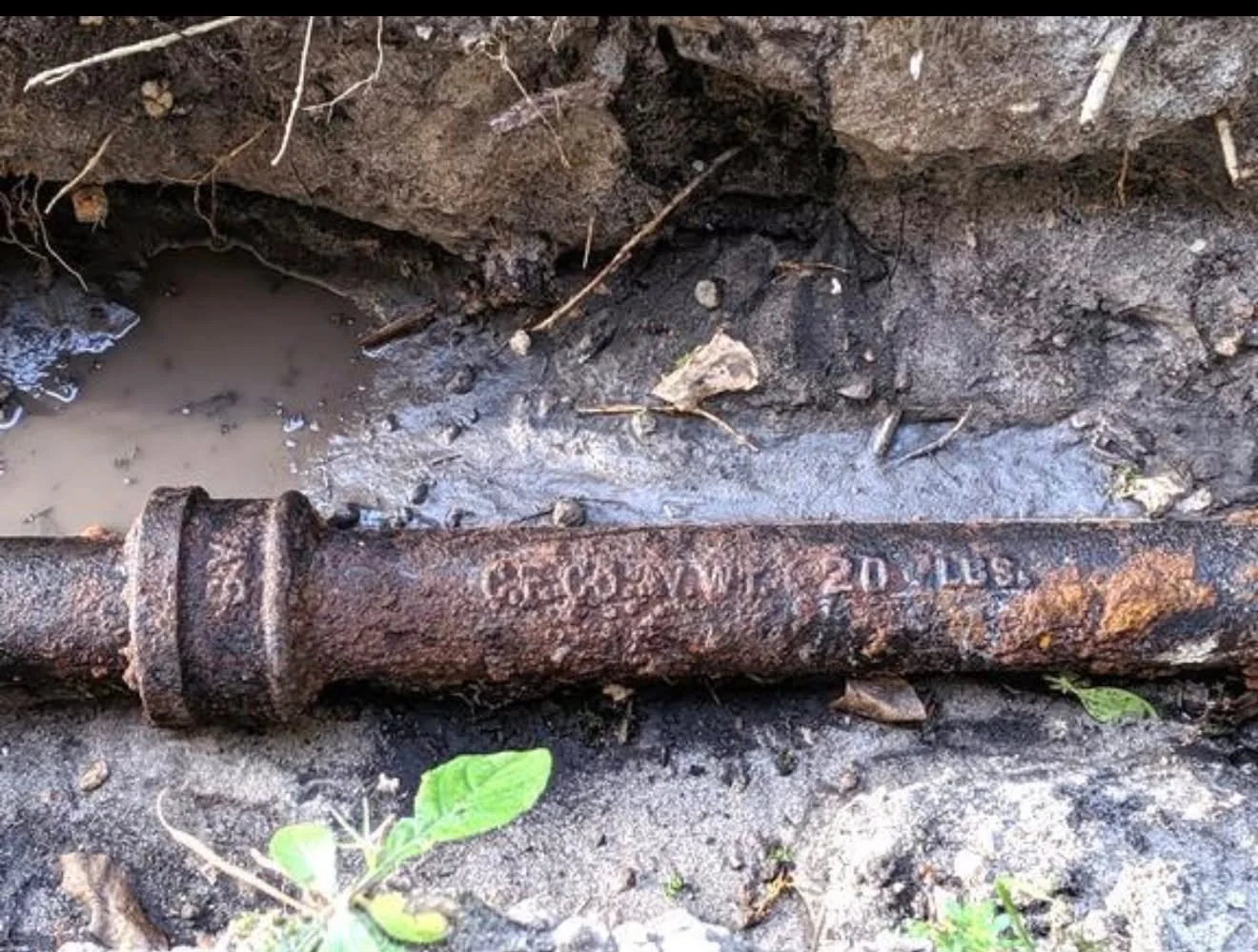
If your house was built back when cast iron was the standard drain pipe, there is a good chance some of it is still down there carrying everything the house sends. Plenty of older homes in Mobile County still have it, under slabs, in crawlspaces and out in the yard to the sewer. Cast iron was good pipe. It is heavy, it is quiet, and a lot of it lasted a very long time. But it does not last forever, and it fails in a way that is hard to see until it is well along.
I work on a lot of these systems, and the conversation with the owner usually starts with a drain that keeps backing up or a smell that will not go away. By the time they call me, they have often had the line cleared once or twice already. Clearing it helped for a while, then it came back. That pattern is one of the clearest signs that the pipe itself is part of the problem.
How cast iron fails from the inside
Cast iron rusts. The outside of a buried pipe rusts slowly, depending on the soil. The inside is where the real damage happens, because the inside is wet, gets air, and carries everything that goes down the drains. Over the years, rust builds up on the inner wall in rough lumps and ridges. That buildup is called scale, and it does two things at once. It narrows the pipe, and it gives everything going by a rough surface to catch on.
Paper, grease and hair catch on scale the way they would catch on a cheese grater. A little catches, then more catches on that, and the line closes a little at a time. That is why an old cast iron line can clog over and over even when nobody in the house is doing anything wrong. The pipe is grabbing what used to slide by.
Meanwhile the bottom of the pipe is wearing away. Water runs along the bottom of a horizontal drain, and over years the iron there rusts and erodes until a channel forms. On a badly worn line, the bottom of the pipe can be gone in places, with the water running over dirt or a crust of rust where iron used to be. From inside the house, nothing about that shows. The drains still drain, until the ground under that spot washes out or the line collapses.
When I cut out a bad section, the bore is often nearly closed with corrosion. A pipe like that can still pass water slowly, which is why people live with it for years without knowing.
Cracks, joints and roots
Scale and channel rot are the slow failures. Cracks are the faster ones. Cast iron is strong but brittle, and when the ground moves, it can crack along its length instead of bending. Settling, a heavy truck parked over a shallow line, roots pushing on it, or clay soil that swells and shrinks with the rain can all do it. Around here, with the clay and a high water table that comes up fast after a storm, ground movement is a real part of why these lines fail.
The joints are another weak spot. Older cast iron was joined with hub-and-spigot joints packed with oakum and sealed with lead. Those joints can loosen as the ground moves. Out in the yard, a loose joint lets in roots, because a sewer line is a source of water and nutrients and a root will find the smallest gap. Once a root gets in, it grows into a mat inside the pipe that catches everything going by.
The vertical pipes fail too, just differently. The main stack that runs up through the walls and out the roof carries waste down and vents gas up, and on old cast iron it can crack along its length or rust through at a joint. A stack leak shows up as a stain on a wall or a ceiling below a bathroom, or a smell in one room that nobody can explain. Water does not sit in a vertical pipe the way it does in a horizontal one, so stacks usually hold up longer, but they are worth a look when the horizontal lines are already in rough shape.
The signs an old cast iron line is in trouble
- The same drain clogs again and again. Cleared a few months ago and backing up again.
- Several drains slow down together. Especially the lowest ones in the house, like a tub or a shower.
- Gurgling in the toilets or drains. Air moving through a line that is partly closed.
- Sewer smell indoors or in the yard. A crack or a hole lets gas out where it should not be.
- Soggy or sunken spots in the yard. Over the sewer route, especially when it has not rained.
- Rust flakes or debris coming back up. Bits of scale that came loose show up in a tub or a floor drain.
None of those proves the pipe is shot. They do mean it is worth looking at before the next time it backs up, and looking means a camera.
What a camera shows on cast iron
A sewer camera is a small waterproof camera on the end of a long cable. I feed it into the line from a cleanout and push it down the pipe while we watch the screen together. On cast iron, the picture tells me most of what I need to know. Heavy scale looks like rough orange and brown lumps around the walls of the pipe. Channel rot shows as a groove or a gap along the bottom where the water runs. Cracks show as dark lines, and a hole shows as dirt where there should be pipe. Roots look like hair or a mat hanging into the pipe from a joint.
The camera also tells me where each problem is. The footage counter on the cable tells me how far out the problem sits, which is where any digging starts. That matters, because it turns a vague idea that the line is bad somewhere into a known spot under the kitchen or a known distance out into the yard. You get to see the footage, and I tell you plainly what I would do about it. The drain camera inspection page covers what that visit involves.
Clearing a cast iron line restores flow for a while. It does nothing to put back iron that has already rusted away.
Clearing the line versus fixing the pipe
If a line is clogged, clearing it comes first, because you need your drains. A cable with the right head will cut through roots and break up a clog, and on scaled cast iron it can knock some of the scale loose too. That is real drain cleaning, and sometimes it is all the line needs for a good while. But on a line with heavy scale, cracks or a rotted bottom, clearing it is buying time. I would rather tell you that than come back every few months and clear it again without saying anything.
Spot repair or replacing the run
Once the camera shows what is going on, the decision usually comes down to whether the damage is in one place or everywhere.
Spot repair makes sense when most of the line looks decent and the problem is one cracked section, one root-invaded joint, or one stretch where the bottom has rotted out. I dig or open the floor at that spot, cut out the bad section, and connect new PVC to the good cast iron on each end with the right couplings. On a yard line, that is a dig in one spot. Under a slab, it means opening the floor over that section only. Spot repairs are a fraction of the work of a full replacement, and on the right line they hold well. That is the kind of job on the sewer line repair page.
Replacing the run makes sense when the camera shows scale from one end to the other, channel rot in several places, or more than one crack or break. Patching one spot on a line like that just moves the next failure down the pipe. Replacing the run means taking out the cast iron between two points and putting in new pipe, usually PVC. In the yard, that is a trench from the house to where the line meets the sewer or the next good section. Under a slab, it means opening a path through the floor, or in some houses rerouting the drain. In a crawlspace it is much easier, because the pipe is right there. The sewer line replacement page goes through how that job runs.
On a repair day, the drains in the house are out of service while the line is open, so I tell you ahead of time how long that will be and plan the work so the house is usable again as soon as possible. Before anything gets buried or the floor gets closed back up, the new section gets checked for flow and for leaks at every coupling, and I run the camera through the finished line so you can see the new pipe and the transitions on the screen.
You see the footage, and you make the call. If I think a spot repair will hold, I say so, and if I think it will not, I say that too, along with why.
Slab houses versus crawlspaces
Where the pipe runs changes the job more than anything else. In a house on a crawlspace, the drain lines hang under the floor where I can get to them, and replacing a section of cast iron is a matter of crawling under, supporting the pipe, cutting it out and putting in new. In a slab house, the drains run under the concrete, and any repair there means opening the floor, which affects flooring, cabinets and how long the job takes. When the cast iron under a slab is bad throughout, rerouting new drains can sometimes avoid a lot of concrete work, but it depends on the layout.
What not to pour into an old cast iron line
Caustic chemical drain cleaners are hard on old pipe. They sit in the low spots of a line and work on the iron as well as the clog. On a line that is already thin, that is the last thing it needs. If a drain is slow, a plunger, a drain screen and hot water will do more good. Keep grease out of the kitchen sink. Keep wipes out of the toilets. On cast iron, everything that goes down has a rough wall to catch on.
What to tell me when you call
Tell me which drains back up first and how often. Tell me whether the house is on a slab or a crawlspace and roughly how old it is. If you know where the outside cleanout is, tell me that too, because it is where I usually start. If you have had the line cleared recently, tell me what they found. Photos of cast iron work I have done are on the gallery page, and you can reach me from the contact page.
Questions people ask about this
How do I know if my house has cast iron drains?
Look where a drain pipe is exposed, under the house in a crawlspace, in a utility room, or where the main stack comes out near the foundation. Cast iron is dark, heavy and rough, with large hubs at the joints. A magnet will stick to it, which it will not do on PVC.
Does all old cast iron need to be replaced?
No. Some of it still has plenty of life, and the only way to know is to look inside with a camera. I have seen old lines in good shape and newer ones in bad shape, so the age of the house alone does not decide it.
Can old cast iron be cleaned instead of replaced?
Clearing it can get rid of clogs, roots and some of the scale, and that restores flow. It does not put back iron that has rusted away or close a crack. On a line with a rotted bottom, cleaning buys time, and I will tell you that.
Can you replace just part of a cast iron line?
Yes. If one section is bad and the rest is sound, that section gets cut out and replaced with new pipe tied into the good cast iron on each end. The camera tells me whether a spot repair will hold.
Why does my old drain keep clogging even though we are careful?
Scale on the inside of the pipe gives paper and grease something to catch on, and a little at a time the line closes. Nobody in the house caused that. A camera will show how much scale is in there.
Old house, drains acting up?
Call and tell me roughly how old the house is, whether it sits on a slab or a crawlspace, and which drains back up first.