

Most people have never seen the inside of their own sewer line, and there is no reason they would have. It is buried, it is out of sight, and as long as the toilets flush nobody thinks about it. Then a drain backs up for the third time in a year, or a home inspector writes a note about the sewer, and suddenly the question is what is actually going on down there. A camera answers that. It replaces a guess with a picture you can watch with your own eyes.
I run a camera on a lot of jobs, and I like having the owner standing next to me watching the screen. It changes the conversation. Instead of me telling you the line has a problem and you deciding whether to trust me, you see the roots or the crack or the low spot yourself. Then we talk about what to do with what we are both looking at.
What a camera run is
A sewer camera is a small waterproof camera head with its own lights, mounted on the end of a stiff push cable wound on a reel. I feed the head into the drain through a cleanout and push it down the line by hand while the picture shows on a monitor. The cable has a counter, so I always know how far the head has traveled from where it went in. The cable has a footage counter, so when the camera reaches a problem I know how far out from the cleanout it is.
The way in is usually the outside cleanout, the capped pipe sticking up near the foundation or out in the yard. If there is no cleanout, I can sometimes go in through a roof vent, or by pulling a toilet and going in at the floor. Each of those works, but a cleanout is the cleanest and the easiest, and if a house does not have one that I can reach, adding one is often worth talking about on its own.
If you do not know where your cleanout is, look along the foundation on the side of the house where the bathrooms are, and in the yard in a line toward the street. It is usually a white or black capped pipe a few inches across, sometimes buried under mulch or grass.
What shows up on the screen
A healthy line looks boring. A smooth round pipe, joints that line up, water running along the bottom in a thin even stream, and nothing hanging into the pipe. When something is wrong, it is usually clear on the screen once you know what you are looking at.
- Roots. Fine hairs or a thick mat hanging into the pipe, nearly always at a joint, because that is where the gap is.
- A sag, or belly. A low spot where the pipe has settled. The camera goes under water for a stretch, and debris collects there because the water sits instead of running.
- An offset joint. Two sections of pipe that no longer line up, so one edge sticks into the flow like a step. Things catch on that step.
- Scale. Rough orange and brown buildup on the walls of old cast iron pipe, narrowing it.
- Cracks and breaks. Dark lines in the pipe wall, or a section where you can see dirt instead of pipe.
- Grease. White or gray buildup coating the walls, mostly in lines that serve the kitchen.
- Something that should not be there. Wipes, a toy, a chunk of something flushed, or a piece of a broken pipe.
Each of those has its own answer. Roots can be cut and the joint repaired. A belly usually needs the low section dug up and re-laid at the right slope. An offset can sometimes be repaired in one spot. Grease can be cleared. Scale and widespread cracking point at a bigger repair. The camera tells you what kind of bad you have, and that decides the fix.
The camera tells you what needs fixing, where it is and how deep, before anybody picks up a shovel.
When a camera run is worth doing
A camera run is not something every house needs every year. It earns its keep in a few specific situations.
The same drain keeps clogging. If a line has been cleared once and it comes back, something in the pipe is grabbing what goes by. Clearing it again without looking is guessing. One camera run tells you whether it was a one-time clog or a structural problem that will keep coming back.
Before a sewer repair. Digging without a camera is digging blind. The camera tells me where the problem is and how deep, which can be the difference between a short dig in one spot and tearing up the yard from the house to the street. I would not quote a sewer repair without one.
Buying a house. This one gets overlooked more than any other. A standard home inspection looks at what the inspector can see, and the sewer line is not something they can see. A house can pass inspection with a sewer line full of roots or a section that has collapsed. Once you close, it is yours. If you are buying an older home, especially one with cast iron or clay under it, a camera run before closing is one of the cheapest bits of protection in the whole deal. I talk about that more on the plumbing inspections page.
A big tree near the sewer route. Roots are one of the most common reasons I find a line failing, and they go where the water is. If a large oak or a row of shrubs sits over the path from the house to the street, a camera tells you whether the roots have found the pipe yet, while the fix is still small.
After work near the line. A new driveway, a pool, utility work, or heavy equipment on the lot can shift or crack a shallow sewer line. If drains start acting up after that kind of work, a camera can tell you whether it is related.
What a camera cannot tell you
A camera shows the inside of the pipe. It does not show the outside, so a pipe can look fine from inside while the soil around it is washing out. It cannot see through standing water, so in a belly the picture goes murky until the head comes out the other side. It cannot see through a heavy clog, so a line that is fully stopped up usually gets cleared first and filmed second. And a camera does not measure how much life a pipe has left. It shows what the pipe looks like today, and I use that to tell you what I would expect from it.
Finding the spot from above ground
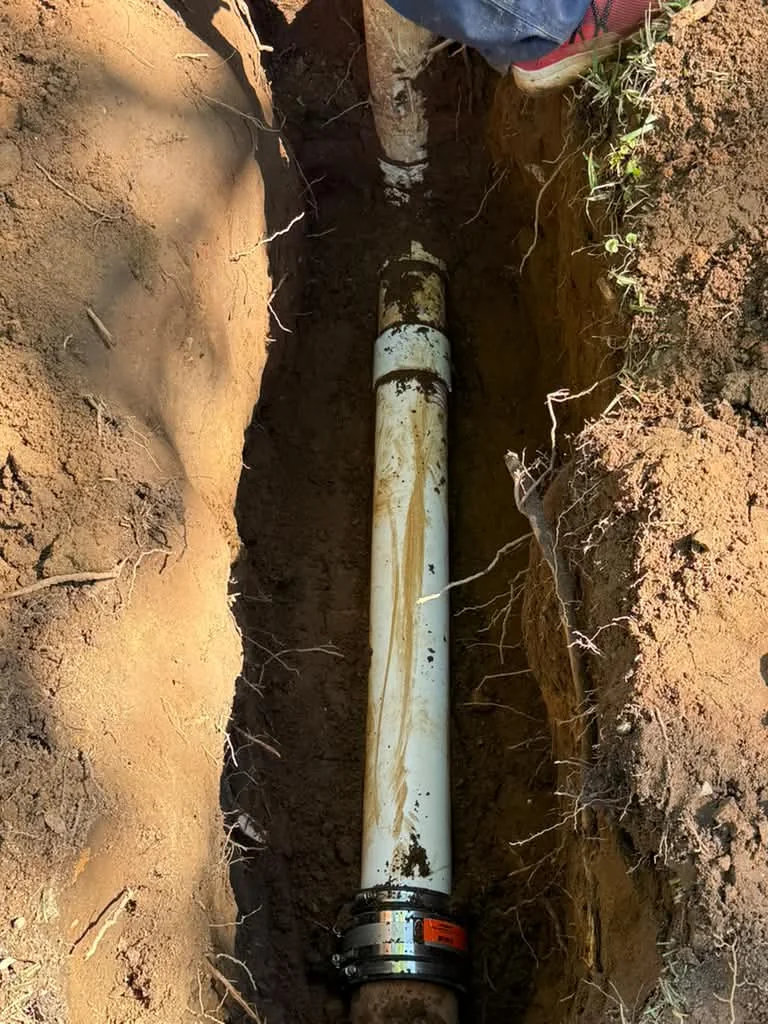
When the camera finds a problem, I stop the head right there. Then I measure that distance out along the line’s path and mark the spot on the ground. Depth gets confirmed when the dig starts, not guessed at from the surface. Now I know the problem is, for example, a certain distance out from the foundation and a few feet down, under the edge of the driveway or in the flower bed.
That is what makes a repair a small job instead of a big one. If the problem is one bad joint, the dig is right over that joint and nowhere else. On jobs where the old line meets new pipe, the camera is also how I check the transitions afterward, so the finished line gets the same look the broken one did.
What happens after the camera
Sometimes the answer is nothing. The line looks good, the clog was a one-time thing, and you have peace of mind and you have seen a healthy line with your own eyes. Sometimes the answer is a cleaning with the right tool for what we saw. Roots get a cutting head, grease gets a different approach, and that is regular drain cleaning done with a plan. And sometimes the answer is a repair, in which case you already know where, how deep and why. The sewer line repair page covers what those repairs look like.
If you are buying a house, the footage is something you can take to the seller. Having watched a camera run that shows a collapsed section or a belly full of debris is a lot more persuasive in a negotiation than a vague worry. I am not the one negotiating, but I can tell you what I saw in plain words and what fixing it would involve.
Keep whatever footage or notes you get from a camera run with your house papers. If the line was clean, you know what it looked like on that day, and the next time something happens that is the starting point. If it showed roots starting at one joint, you know where to look first in a few years. A line that was filmed once is a line with a history, and a history saves time on every call after.
How long it takes
On a line with a good cleanout and nothing blocking it, the camera part is not a long visit. Most of the time goes to getting access, running the head slowly enough to see the joints properly, and locating anything worth marking. If the line has to be cleared first, or there is no cleanout and I have to go in through a toilet or the roof, add time for that. I tell you before I start which way it is going to go, so you are not left wondering.
How the three counties differ
In Mobile County, the older houses carry a lot of cast iron and clay, and those lines fail with scale, cracks and roots at the joints. Baldwin County’s newer houses usually have PVC drains, which do not scale, but a line laid on poorly packed soil can sag, and joints can pull apart when the ground settles. Many Washington County homes are on septic rather than a sewer main, and there the camera is just as useful for the line from the house to the tank as it is anywhere else. The tool is the same, but what I expect to find changes with the house.
What to tell me when you call
Tell me why you want it looked at. A drain that keeps clogging and a house you are about to buy are different jobs with different questions. Tell me where the cleanout is if you know, and whether the line is backed up right now, because a stopped line usually needs clearing before the camera can see anything. The drain camera inspection page has more on what to expect, some of my camera and dig work is on the gallery page, and the contact page has my number.
Questions people ask about this
Can I watch while you run the camera?
Yes, and I would rather you did. It is much easier to understand what a line needs when you see it yourself. If you cannot be there, I will walk you through what I saw, section by section, before anything gets decided.
Do I need a camera inspection if my drains are working fine?
Usually not, unless you are buying a house or there is a big tree near the sewer route. The time to look is when there is a reason: repeat clogs, a sale, or work being done near the line.
What if my line is completely clogged?
The camera cannot see through a full blockage, so the line usually gets cleared first. Once water is moving, the camera goes in to find out what caused it.
Will a camera inspection damage my pipes?
No. The camera head is pushed gently by hand and is built to move through drain lines. On a pipe that is already broken, I go carefully and stop if the head reaches a spot it should not go past.
Is a camera inspection part of a normal home inspection?
Usually not. A standard home inspection covers what the inspector can see, and the sewer line is buried. If the house is older or has large trees near the sewer route, it is worth adding a camera run before you close.
Want to see inside your line?
Call and tell me why you want it looked at, whether that is a drain that keeps clogging or a house you are buying, and where the outside cleanout is if you know.