
Toilets have two classic problems, and they could not be more different. One rocks when you sit on it. The other runs when nobody has touched it. A rocking toilet is about what is under it: the seal, the flange and the floor. A running toilet is about what is inside the tank. One of them can quietly rot a bathroom floor, and the other can quietly run up a water bill. Neither should be ignored, and neither is usually a reason to buy a new toilet.
I fix a lot of both. Most of the time the repair is small, and I would rather tell you that than talk you into a new toilet you did not need. When a toilet really is done, I will tell you that too, along with why.
A toilet that rocks
A toilet is held to the floor by two bolts that come up through the base from a flange underneath. The flange is the ring fastened to the floor and connected to the drain pipe. Between the bottom of the toilet and the flange sits a wax ring, which seals the drain so water and sewer gas cannot escape. When everything is tight and level, the toilet does not move at all.
When a toilet starts rocking, one of a few things has happened. The bolts may have loosened. The floor under the toilet may not be level, so it sits on a high spot. The flange may be cracked or broken, so the bolts have nothing solid to hold. Or the floor itself may be soft from water damage, and the whole thing is sinking a little each time someone sits down.
Every time a toilet rocks, it works the wax ring. A wax ring that has been squeezed and pulled back and forth stops sealing, and then water leaks out under the toilet every time it is flushed, where you cannot see it.
What to check yourself
Pop the caps off the bolts at the base of the toilet and check whether the nuts are loose. If they are, you can snug them a little at a time, alternating sides. Go gently. Porcelain cracks, and overtightening is one of the most common ways people break a toilet base. If a quarter turn on each side stops the rocking and the floor feels solid, you may be done.
If the nuts are already tight and it still rocks, the problem is underneath, and tightening harder will not fix it. Look for water at the base after a flush, discoloration or soft spots in the floor around it, a sewer smell in the bathroom, or a stain on the ceiling below if it is on a second floor. Any of those means the seal has already failed and water has been getting out.
The wax ring, the flange and the floor
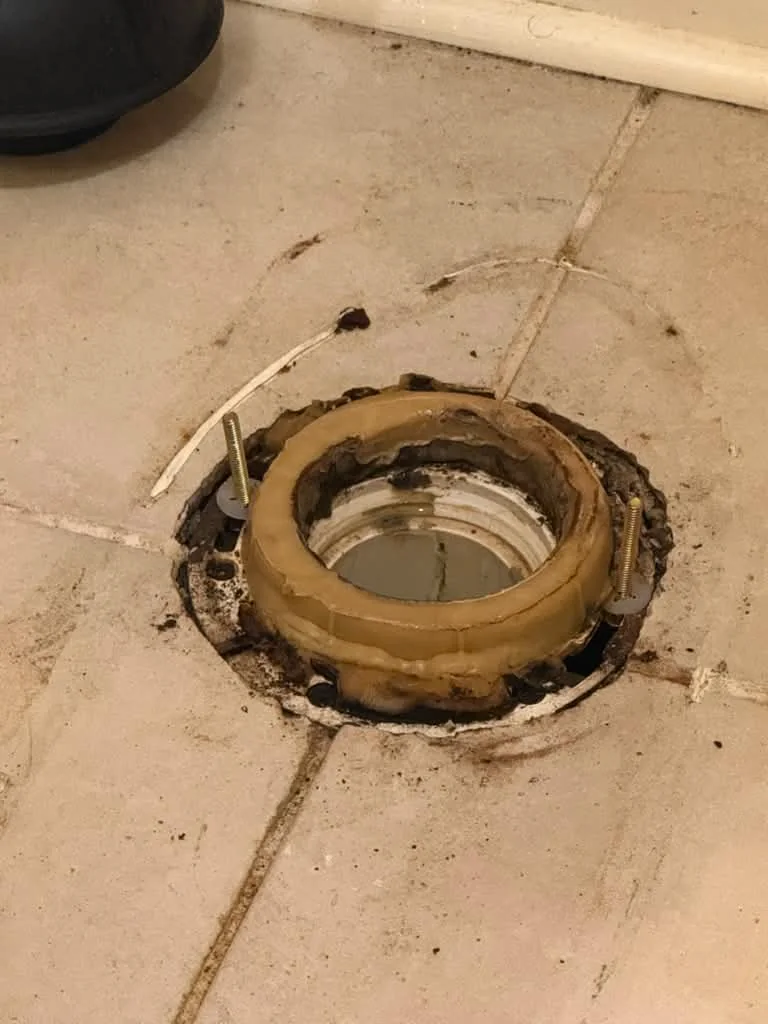
To fix a toilet that rocks for real, it has to come up. I shut off the water, drain the tank and bowl, disconnect the supply line, and lift the toilet off the flange. Then I can see what is going on. The photo at the top of this post is what that looks like: an exposed flange in a tile floor with the old wax ring still on it.
The wax ring gets replaced every time a toilet comes up. A used ring does not reseal, and there is no saving it.
The flange gets a close look. If it is cracked, broken or has a corroded metal ring, it needs repair or replacement. If it sits too low, below the finished floor because tile was added on top of the old floor, the wax ring has to stretch to reach it and never seals well. There are ways to raise a flange to the right height, and that fixes a lot of toilets that have been reset over and over without solving anything.
The floor under the flange is the last thing to check, and the one that matters most if it has gone soft. A wax ring that has leaked for a long time rots the subfloor. If the wood around the flange is spongy, it needs to be cut out and replaced, or the new toilet will start rocking again in short order. That is a bigger job, and you will hear about it before I start.
Setting a new wax ring on a broken flange or a rotted floor just schedules the next leak, and that leak goes where you cannot see it.
Once everything underneath is sound, the toilet goes back down on a new ring, level, with shims if the floor needs them, and the bolts get snugged evenly. Then I flush it several times and check the base.
A toilet that runs
A toilet that runs on its own, refills every so often when nobody has used it, or keeps hissing after the tank is full is wasting water every minute it does it. People live with it for months because it is just a little noise. But a running toilet can use a surprising amount of water in a month, and you do not notice until the bill shows up. On a house with a septic system, which is a lot of Washington County, all that water goes into the tank and the drain field too. On a well, it keeps the pump cycling.
Almost every running toilet comes down to a couple of parts inside the tank: the flapper and the fill valve. Sometimes the flush valve itself is involved. These are inexpensive parts, and fixing them is a short visit.
The food coloring test
Here is the easiest test in plumbing. Take the lid off the tank and put a few drops of food coloring in the water. Do not flush. Wait fifteen or twenty minutes. If color shows up in the bowl, the flapper is leaking. Water is seeping past it from the tank into the bowl, and the tank refills to make up for it. That is the phantom refill you hear in the middle of the night.
If no color shows up in the bowl, but the toilet still runs, look at the water level in the tank. There is a tube in the middle called the overflow tube. If water is running down into it, the fill valve is letting water in past the level it should stop at. Either the float is set too high, or the fill valve is worn and does not shut off completely.
- A worn or warped flapper. Rubber gets stiff and warped over time, especially on hard water, and stops sealing.
- A chain that is the wrong length. Too short and it holds the flapper open a little. Too long and it gets caught under the flapper.
- A fill valve that will not shut off. Worn seals let water keep trickling in.
- A float set too high. The water rises above the overflow tube and runs down it constantly.
- A worn flush valve seat. Mineral buildup or damage on the seat the flapper closes against.
On well water, especially out in Washington County, minerals and sediment make all of these wear faster. A fill valve that clogs with grit can stick open, and a flapper on hard water can warp sooner. It is worth checking your toilets more often if you are on a well.
Other places a toilet leaks
Not every puddle near a toilet is the wax ring. The bolts that hold the tank to the bowl have rubber washers, and when those wear, water drips from under the tank with every flush. The gasket between the tank and the bowl can fail the same way. The supply line and the shutoff valve behind the toilet can weep at their connections. And in the humid months, a tank full of cold water sweats, and the condensation runs down and drips onto the floor. Sweat shows up on the outside of the tank on muggy days and stops when the weather turns, which is how you tell it apart from a real leak.
A dry paper towel is the best tool for this. Wipe everything dry, flush, and press the towel around the tank bolts, under the supply connection and around the base. Wherever it comes back wet first is where the water is coming from.
A weak flush
A toilet that flushes weakly, or needs two flushes to clear, is a third common complaint. Sometimes the water level in the tank is set too low. Sometimes the flapper chain lets the flapper close too early. On hard water and well water, the small holes under the rim and the jet at the bottom of the bowl can scale up with minerals, so less water comes through them with each flush. Those can often be cleared. If the bowl itself is the problem, that is one of the times a new toilet makes sense.
Repair or replace
Most toilets do not need replacing. A flapper, a fill valve, a wax ring and a flange repair cover the large majority of problems. A tank that runs is never, by itself, a reason to buy a new toilet. That is the honest answer, and I give it every time.
There are real reasons to replace one, though. A cracked tank or bowl is done, because porcelain cannot be repaired. An old toilet that uses a lot of water per flush is worth thinking about. A toilet that clogs regularly with normal use can have a restricted trap built into the bowl, and no part fixes that. And if parts for an odd or old model are not available, a new toilet is often the simplest path. The toilet repair page covers the repairs, and the toilet installation page covers what goes into setting a new one properly.

When a new toilet goes in, it gets a new wax ring, new bolts, a flange that is sound and at the right height, and a new supply line. Braided supply lines are the norm now, and if yours is old or the shutoff valve behind the toilet is seized, that is a good time to replace them. A supply line or a shutoff is a small part, and it is the kind of small part that causes a big water loss when it fails.
When it is part of a bigger job
If you are remodeling a bathroom, moving a toilet or changing the floor, the toilet flange and drain are part of the plumbing that should be done right while the floor is open. That falls under bathroom plumbing, and it is the best time to fix a flange that was always a little low or a drain that was always a little off.
What to tell me when you call
Tell me whether the toilet is rocking or running, or both. If it rocks, tell me whether the nuts at the base are loose, whether there is water at the base after a flush, and whether the floor around it feels soft. If it runs, tell me whether the food coloring showed up in the bowl and whether water is running down the overflow tube. That tells me which parts to have on the truck. Some of my toilet and bathroom work is on the gallery page, and my number is on the contact page.
Questions people ask about this
Can I just caulk around a toilet that rocks?
Caulk can hide a small gap, but it does not hold a toilet down or fix the seal. If the toilet still moves, the wax ring keeps working loose. Fix the cause first, then caulk if you want a finished edge.
How do I know if my wax ring is leaking?
Water at the base after a flush, a sewer smell in the bathroom, a soft or stained floor around the toilet, or a stain on the ceiling below are the usual signs. A toilet that rocks is often the reason it started leaking.
Why does my toilet refill by itself in the middle of the night?
That is usually the flapper letting water seep from the tank into the bowl. The tank refills to make up for it. A few drops of food coloring in the tank will confirm it.
Is it worth fixing an old toilet?
If the porcelain is sound and parts are available, usually yes. A cracked tank or bowl, a model that uses a lot of water per flush, or a toilet that keeps clogging are reasons to replace it.
How often should a wax ring be replaced?
Only when the toilet comes up or the seal fails. A wax ring that is not disturbed can last a long time. Every time a toilet is pulled, it gets a new one.
Toilet rocking or running?
Call and tell me which one it is, whether there is any water at the base, and whether the floor around it feels soft.