
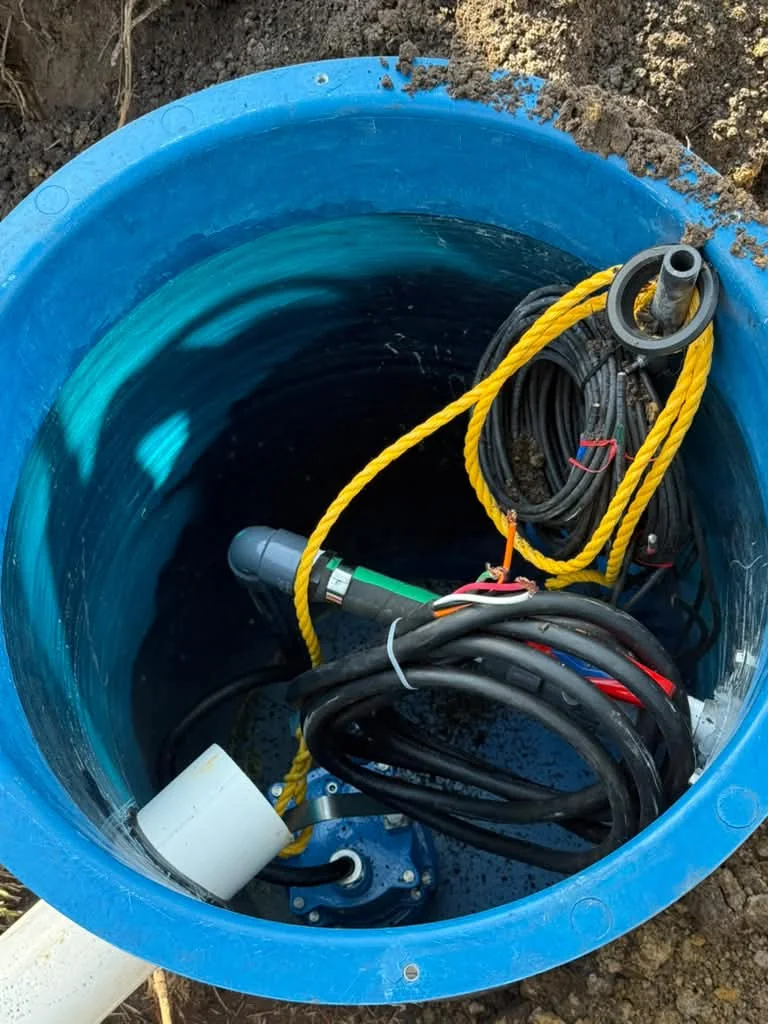
Most people learn they have a grinder pump problem the same way: a red light on the box beside the house and a horn they never knew it had. The question that comes next decides the day, the mess and what you end up paying for. Is the pump itself worn out, or is something around it giving it bad information? A grinder station is three parts working together. There is the pump down in the basin, the level controls that tell it when to run, and the control panel that switches the power. Any one of them can trip the alarm.
I would rather know which one it is before anything gets pulled out of the ground. Here is how I sort it out, and what you can notice yourself while you wait for me.
Listen before anything else
With the horn silenced, stand near the basin lid and listen. A pump that hums but never changes the sound of the water has power and cannot turn. That usually means the cutter is jammed on something it could not chop, or the motor has seized. A pump that makes no sound at all is either getting no power or has died outright. A pump that runs, stops, then starts again a minute later and never seems to settle is often mechanically fine. It is either being misled by a level control, or it is losing the water it just pushed out back through a worn check valve. Those three sounds point at three different parts, and I ask about them on the phone because the answer changes what goes on the truck. If you can, also notice whether the house lights dim when it tries to start. A motor straining against a jam does that. A dead circuit does not.
What lives inside the panel
The box on the wall or the post is where most of the inexpensive failures hide. Open one up and you find one or two contactors, which are heavy switches that send power to the pump when the level calls for it. There is a terminal strip where the float and pump wires land, a breaker, and the alarm circuit with its red light and horn. Contactors pit and burn at the contacts after years of cycling. Terminals loosen and corrode, and in damp Gulf Coast air a little moisture inside a box goes a long way. Wasps and ants like the warmth in there too. When the panel is at fault, the pump in the basin is often perfectly healthy and simply never got the signal to run. I test the panel with a meter before anything else, because replacing a good pump that was never the problem is exactly the kind of mistake that makes people stop trusting plumbers.
Floats tell the pump when to run
Depending on the system, the level controls are floats hanging on cables, a sealed sensor, or a tube that reads air pressure as the basin fills. Every one of them can fail in a way that looks like a dead pump. A float coated in grease or tangled with its neighbor stays put no matter what the water does. Stuck low, it never starts the pump, and the alarm float sitting higher up eventually trips. Stuck high, it keeps the pump running until the motor overheats or runs dry. A float cable that got nicked when the basin was set can short out on some days and behave on others. I check the controls by watching the panel as the level changes and seeing whether the right contactor pulls in when it should. If a float or sensor is the fault, that is a part, and the pump stays right where it is.
Flipping the breaker off and on, or pressing the reset over and over to quiet the horn, hides the very symptom I need to see. If the pump is jammed, every restart puts more heat into the motor. Silence the alarm, stop sending water down the drains, and leave the breaker alone until someone has looked.
When it really is the pump
Some pumps are simply done. The signs are a motor that trips its breaker the instant it starts, a pump that gets the right power and the right signal and still cannot bring the level down, or a cutter worn so far that it passes rags and stringy material it once chopped fine. To confirm it, the pump has to come up. On most stations it lifts out along a rail and unhooks from a fitting at the bottom, so nobody climbs into the basin. Once it is lying on the grass I can turn the cutter by hand, look at the impeller, check the cord and the seal, and see what it was fighting. Sometimes the whole story is a wad of wipes wound around the cutter, and the pump goes back down clean. Sometimes the motor is gone, and a new pump goes in on that same rail.
Rain, groundwater and a pump that runs too much
A grinder that runs far more often after a heavy rain is telling you water is getting into the basin that never came from your house. Mobile County ground is sandy on top with clay underneath, and after a storm the water sits in that sand looking for somewhere to go. A cracked lid, a failed seal where the inlet pipe enters the basin, or a gap around the cable entry all let it in. The pump is doing its job, just a great deal more of it, and the extra hours wear it down early. If the alarm only shows up on wet days, or the pump cycles when nobody has run any water, look for a leak into the station before blaming the pump. Sealing it protects whatever pump is down there.
Deciding between a repair and a new pump
Once I know which part failed, the decision is usually plain. A burned contactor, a bad float or a loose terminal is a repair. A seized motor or a worn cutter on a station that is otherwise sound gets a new pump. Where the panel is rusted through and the pump is tired as well, replacing both together can make more sense than two separate visits a year apart, and I will say that when it is true, along with the cheaper path if the cheaper path will hold. You get told which part I found, what it looked like and why I think it caused the trouble. If the pump came up, you are welcome to look at it on the grass with me.
Where a Semmes house has a grinder station, the details you can give me are what shorten the visit: the sound, the light and the weather when it started. The grinder pump repair in Semmes page covers the work itself. You can reach me through the contact page or at (251) 421-0367.
Questions people ask about this
Can I lift the float myself to see if the pump starts?
I would not. The floats hang in raw sewage, and the panel carries live power that is easy to brush while reaching in. What you can safely do is listen at the lid and look at the panel from outside: is the red light on, is the breaker tripped, and did it trip again after one reset. Those answers tell me most of what lifting a float would.
Why does my grinder pump hum but not pump?
A hum means the motor has power and cannot turn. Most often the cutter is jammed on something it could not chop, such as wipes, a rag or a hard object, and sometimes the motor bearings have seized. Turn the breaker off so it stops heating, stop using water, and call. Clearing a jam early can save a pump that has not yet overheated.
How do you tell whether the panel or the pump failed?
If the panel never sends power when the level rises, the pump is innocent. I check that with a meter at the terminals and by watching the contactors as the level changes. If power arrives and the pump still will not move water, the fault is down in the basin. Sorting those two apart first keeps a good pump from being replaced for nothing.
Grinder station acting strange?
Tell me what the pump sounds like right now, whether the red light is on, and whether the trouble started after a hard rain.