Semmes, west Mobile County
Tankless water heater installation, starting with the gas line
Going from a tank to tankless on a Semmes house is mostly gas and water line work with a heater hung at the end of it. Paul Evans checks the gas pipe and the meter first, mounts the unit where it can be serviced, and tells you straight when a well-installed tank would serve the house better.
What a tank-to-tankless swap actually involves
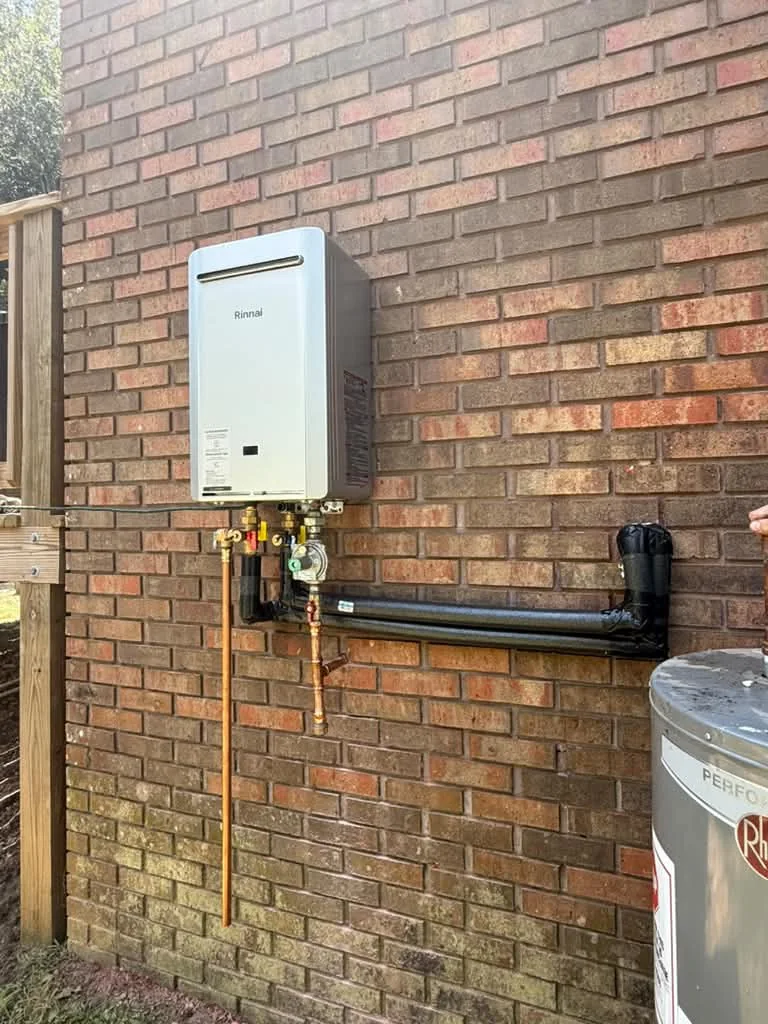
A typical swap looks like this halfway through: the new Rinnai already on the brick wall, the insulated lines run, and the old tank still standing beside it waiting to be drained and disconnected. Hanging the heater is the quick part. Most of the day goes into what feeds it, the gas line, the hot and cold lines rerouted to the outside wall, and the isolation valves that make flushing possible later. The tankless installation page covers the units Paul works with. This one is about doing the work on a Semmes house.
Gas decides the install before the brand does. A tank burner runs at a modest rate for a long time, while a tankless burner fires hard for exactly as long as a tap is open, so at full fire it asks for several times the gas. The size of the pipe from the meter, how far it runs and what else hangs off it, the range, the dryer, a furnace, set what is actually available. Paul measures that before a unit is picked. If the line or the meter cannot feed it, you hear that before anything is bought, and decide from there.
Hot water that quits without warning is a poor moment to plan a tankless properly. One Google review describes hot water going out on a Friday afternoon: “Paul scheduled us with less than a 24 hour notice.” (Carly Firkins, Google review) In that spot, getting hot water back with a replacement tank and planning the tankless later is a fair answer. Old galvanized pipe feeding the heater shows up fast as weak flow, and that is repiping in Semmes. Installs are in the gallery, more local work is on the Semmes page, and you can send Paul the details or call (251) 421-0367.
Details that make a tankless work on day one
These are the parts of the install a homeowner rarely sees, and they are the ones that decide how the heater behaves for years.
Insulated lines outside
An outdoor unit hangs on the wall, but its water lines still run through the weather. Insulating them keeps the summer sun off the pipe and protects it on the occasional hard freeze. Most outdoor units guard their own insides against freezing only while they have power, so steady power to the unit matters more than people expect.
Valves for flushing
Two isolation valves with service ports go on the water lines below the heater. They let the heat exchanger be closed off and flushed with a small pump and descaler without cutting a pipe. On hard water that flush is ordinary maintenance, and a unit installed without the valves turns every future flush into a bigger job than it should be.
Power and condensate
Even a gas tankless needs electricity for its controls, fan and igniter, so an outlet has to be within reach of the mounting spot. Condensing models also make a small, slightly acidic stream of water that needs a drain path, sometimes through a neutralizer. Paul checks which of these the chosen model needs before the wall gets drilled.
The wait at the tap
Endless hot water holds up for as long as the gas keeps pace. The first few seconds at the faucet are another matter, because the water sitting in the pipe between heater and tap still has to clear. A unit also needs a minimum flow to fire, so a barely cracked faucet can run cool. Both are worth knowing before you buy.
When a tank is the better buy
A small household that rarely runs two hot taps at once gets little from tankless. A house with no gas service would need a whole-house electric unit, which asks a great deal of the electrical panel. In those cases a good tank, installed properly, serves the house better.
Is tankless the right call for this house?
Four situations come up most when people ask about switching. Each one points a slightly different way.
If the house runs out of hot water whenever two showers go at once
A tankless can solve it, provided the gas line can feed both at full fire. A larger tank solves it too, so the gas check is what decides between them.
If the house is all electric with no gas service
Whole-house electric tankless takes heavy wiring and a lot of panel capacity. A properly sized electric tank is usually the steadier choice.
If the tank you have now is leaking today
Hot water comes back first. A replacement tank can go in now, and a tankless conversion gets planned once the gas line and the wall location have been looked at.
If the fixtures carry white crust and the shower head keeps clogging
The water is hard, and hard water scales a heat exchanger. Plan on regular flushing from the first day, or on treatment ahead of the heater.
How install day runs
The gas question gets settled before install day. After that, the work follows the same order on every house, start to finish.
- Gas confirmed The line from the meter, its length and every appliance on it are measured, and you know whether it can feed the unit before one is ordered.
- Mount and pipe The heater goes up on the outside wall, the water lines are rerouted, insulated and fitted with isolation valves, and the gas line is brought to its valve.
- Old tank out Water and fuel to the old tank are shut off, then it is drained and disconnected, and the connections it leaves behind are capped clean.
- Fire and test With the gas on and the lines purged of air, the unit fires and gets tested with more than one tap open, and every joint is checked for leaks.
- The walkthrough You see where the valves are, how a flush works and what the error lights mean, so a code on the display is never a mystery.
Tankless questions, answered by the installer
Still not sure? Ask Paul directly.
Will a tankless really never run out of hot water?
It keeps heating as long as water flows and the gas supply keeps up. What it cannot do is heat more water at once than its burner is rated for, so with enough showers and appliances running together the temperature drops. Sizing the unit and the gas line to how the house really uses water prevents that.
Why does Paul look at the gas meter before choosing a unit?
A tankless at full fire draws far more gas than the tank it replaces, and the meter and pipe have to deliver that while the range, dryer or furnace may be running too. A unit starved of gas throws error codes and cold water. Checking first keeps you from buying the wrong heater.
Does a tankless have to go outside?
No, indoor models exist and vent through the wall or roof. Outdoor mounting often suits a brick house because it frees up the old closet and needs no vent pipe. Which one makes sense depends on where the gas and water lines already run and where the unit can be reached for service.
How often does a tankless need flushing?
On hard water, about once a year is a reasonable rhythm, and softer water can go longer. The flush runs a descaling solution through the heat exchanger using the isolation valves installed with the unit. Skipping it lets scale build until the heater starts throwing errors or delivering lukewarm water.
Can the tankless go where my old tank was?
Sometimes. An indoor unit can use the old closet if a vent can be run and the gas line reaches it. Many swaps move the heater outside instead and repipe the hot and cold lines to meet it. Paul looks at both options on the first visit and tells you which is simpler for your house.
Does a gas tankless need an electrical outlet?
Yes. The controls, fan and igniter all run on household current, so the unit needs power within reach of where it hangs. On an outside wall that usually means a weatherproof outlet. It also means a power outage leaves you without hot water until the power comes back, which is worth knowing up front.
Talk the swap through
Tell Paul what heats your water now, gas or electric, and how many people live in the house. He can usually say on the phone whether tankless is worth a closer look.
Talk to Paul (251) 421-0367 Send a message