
Semmes, Mobile County
Grinder pump alarm going off? Find the part that quit first.
A grinder that stops grinding lights up red and starts sounding off, and the basin keeps filling for as long as the house sends water down. Paul works out whether the fault sits in the panel on the wall, the floats or the pump itself before anything is ordered or lifted out of the ground.
What the red light is telling you
The red light and the horn come on when water in the basin climbs past the point where the pump should already have started. There is usually some room left above that line, which is why the first job is to stop feeding it. Hold off on laundry, the dishwasher and long showers, and flush only when you have to. Then find the breaker for the pump in the house panel. If it has tripped, reset it once and listen. If it trips again, leave it off. Pressing the silence button quiets the horn and fixes nothing, so after that, call Paul at (251) 421-0367.
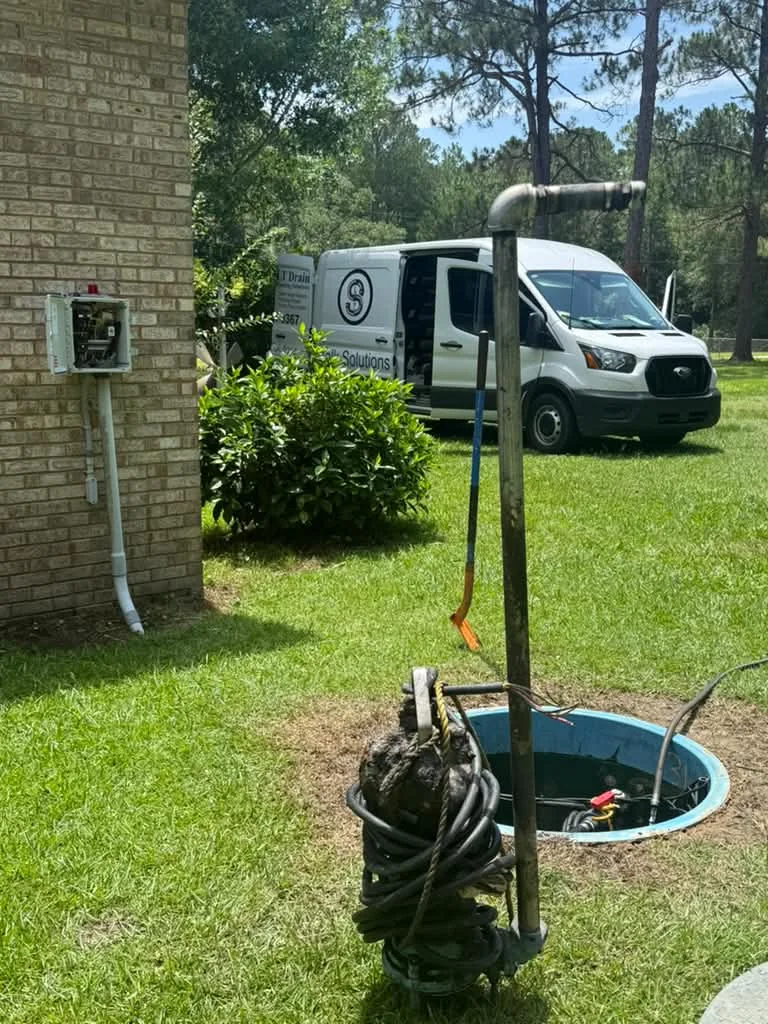
A grinder has three places to fail, and they get checked in the order that costs you least. The control panel on the wall comes first: a meter shows whether power reaches the pump, whether the contactor is closing and whether the alarm circuit is reading the floats correctly. The floats come next, since one hung up on grease or tangled in its own cord tells the panel the wrong story. Only after both of those check out does the pump come up out of the basin on its guide rail, where the cutter and impeller can be looked at in daylight. More on the equipment itself is on the grinder pump repair page.
Sometimes the fix is a float or a contactor and the pump goes back down the rail on the same visit. Sometimes the unit is worn out, and you hear that with a quote. One Google review describes exactly that kind of job: “This time was a complete removal and replacement of a grinder pump and electrical box.” (Robbie Morrow, Google review) If the basin is low and the house still backs up, the grinder is fine and the trouble is in the house drain, which is drain cleaning in Semmes. Pulled pumps are in the gallery, other local work is on the Semmes page, and the contact form reaches Paul directly.
Where grinder trouble usually starts
Most grinder calls trace back to one of these five. Knowing which one you have changes what gets replaced and how long the basin sits full.
Worn contactor
The contactor is the switch inside the panel that sends full power to the pump motor. Every cycle sparks its contacts a little, and after enough years they pit and stop closing cleanly. The pump then starts late, chatters or never starts at all while the alarm does its job. It is a panel part, and replacing it leaves the pump in the ground.
Floats that lie
Floats hang in the basin and tell the panel when to run the pump and when to sound the alarm. Grease coats them, cords tangle around the guide pipe, and a float that cannot rise or drop freely gives the panel bad information. Cleaning and freeing them is often the whole repair, and it is the quickest one there is.
A seized cutter
The grinder head chops waste into a slurry small enough for the discharge line. Rags, dental floss, cooking grease and wipes wrap that cutter until it locks. The motor hums against it, heats up and trips its breaker. Pulled early, a jammed cutter can often be cleared. Run against the jam for days, the motor usually burns out with it.
Flushable is a label
Wipes sold as flushable do clear a toilet. They do not break down in a basin the way toilet paper does, and a grinder sees them in one piece. Grease poured down the kitchen sink cools in the basin and builds a crust on the floats and walls. Between them, they are the most avoidable reasons a pump gets pulled early.
Rain makes it work harder
After a hard rain in Mobile County the ground holds water close to the surface, and a basin with a cracked lid seal or a loose inlet joint lets some of it in. The pump then runs more cycles than the household could account for. That extra running wears the motor and contactor sooner, and the leak is usually findable.
Reading the alarm before Paul gets there
What you can see and hear from the yard narrows the cause a lot, and it helps to say it on the phone.
If the pump breaker trips again right after you reset it once
The motor or its wiring is pulling more current than it should, often because the cutter has seized. Leave the breaker off and keep water use low until the pump comes up.
If you can hear the pump running but the alarm stays on
The motor turns and the water does not leave. That points at a jammed cutter, a stuck check valve or a blocked discharge line leaving the basin.
If the alarm only comes on during heavy rain and clears afterward
The pump is keeping up eventually, which means water is getting into the basin from outside. A lid seal or an inlet joint is the usual way in.
If the basin is full but the panel is dark and nothing hums
Power is not reaching the panel, or the panel itself has failed. That is a quick meter check, and it sometimes means the pump is perfectly fine.
From the phone call to a quiet basin
A grinder visit follows the same order every time, so nothing gets pulled or ordered on a guess.
- Tell Paul Say what the light and horn are doing, whether the breaker tripped and when it started. That shapes what goes on the truck before he leaves the house.
- Meter on the panel Power, contactor and alarm circuit get tested on the wall first, because that work is quick and keeps the pump in the ground when the panel is the fault.
- Pump on the rail If the panel checks out, the pump comes up its guide rail so the cutter, impeller and floats can be seen and handled outside the basin.
- A straight answer You hear what failed, why it failed and whether a part or a new pump makes sense, along with a quote, before a single fitting gets loosened.
- Watch it cycle Water goes into the basin until the pump starts, empties it and shuts off on its own, and the alarm gets tested so you know it will speak up next time.
Grinder questions people ask Paul
Still not sure? Ask Paul directly.
Can I keep using water while the alarm is on?
As little as possible. The alarm sounds before the basin is completely full, so there is some room, but every flush and every load of laundry spends it. Skip the washer and dishwasher, keep showers short, and call. If the breaker keeps tripping, leave it off rather than forcing the pump.
Is it all right to silence the alarm?
Yes, the silence button is there for a reason, and nobody wants a horn going all night. Silencing it does nothing to the water level, though, and the red light normally stays on until the level drops. Treat the light as the real warning and keep water use low until the pump runs again.
Does a grinder pump always get replaced when it fails?
No. Plenty of failures turn out to be a float, a contactor or a jammed cutter that clears once the pump is out of the basin. Replacement comes up when the motor has burned out or the pump is worn through. Paul tells you which one you are looking at before any work starts.
Are flushable wipes really that bad for a grinder?
They are one of the most common reasons a pump comes up early. Wipes hold together in the basin, wrap the cutter and stall the motor. Toilet paper is the only paper that belongs in a grinder system. Kitchen grease is the other repeat offender, because it hardens on the floats and stops them moving.
Why does my pump run so much after a big rain?
Ground around here holds water near the surface after heavy rain, and a basin that is not sealed tight lets some of it in. The pump then works through water the house never used. If the run time climbs with every storm, the lid seal and the inlet joint are where Paul looks first.
How do I tell a grinder problem from a clogged drain?
Look at the alarm first. A grinder that has failed almost always lights the panel before the house backs up. If the light is off, the basin is low and a tub or toilet is still slow or backing up, the blockage is in the house drain somewhere between that fixture and the basin.
Get the basin quiet again
The light, the horn and how long it has been going are enough to start with. Paul picks up, asks a couple of questions and gives you a time he will be there.
Call Paul (251) 421-0367 Send Paul a message