
Semmes, Mobile County
Repiping a Semmes house you still have to live in
When the supply pipes in a house have closed up with rust or started leaking at one fitting after another, patching stops paying off. Paul Evans plans a repipe around the way your household runs. The walls get opened only where new lines have to pass, and every fixture ends up with a shutoff of its own.
What actually wears out in a supply line
Galvanized steel rusts from the inside, so the opening a pipe started with gets smaller every year until the shower barely runs and the kitchen faucet spits brown after a week away. Polybutylene, the gray plastic supply line builders eventually gave up on, fails a different way: the pipe and its fittings turn brittle and can let go without warning. Copper lasts longer, though a pinhole in one spot often means the wall is thin everywhere. Wherever a Semmes house falls on that list, Paul starts by looking at what is actually in your walls and ceilings. More about his work around town is on the Semmes page.
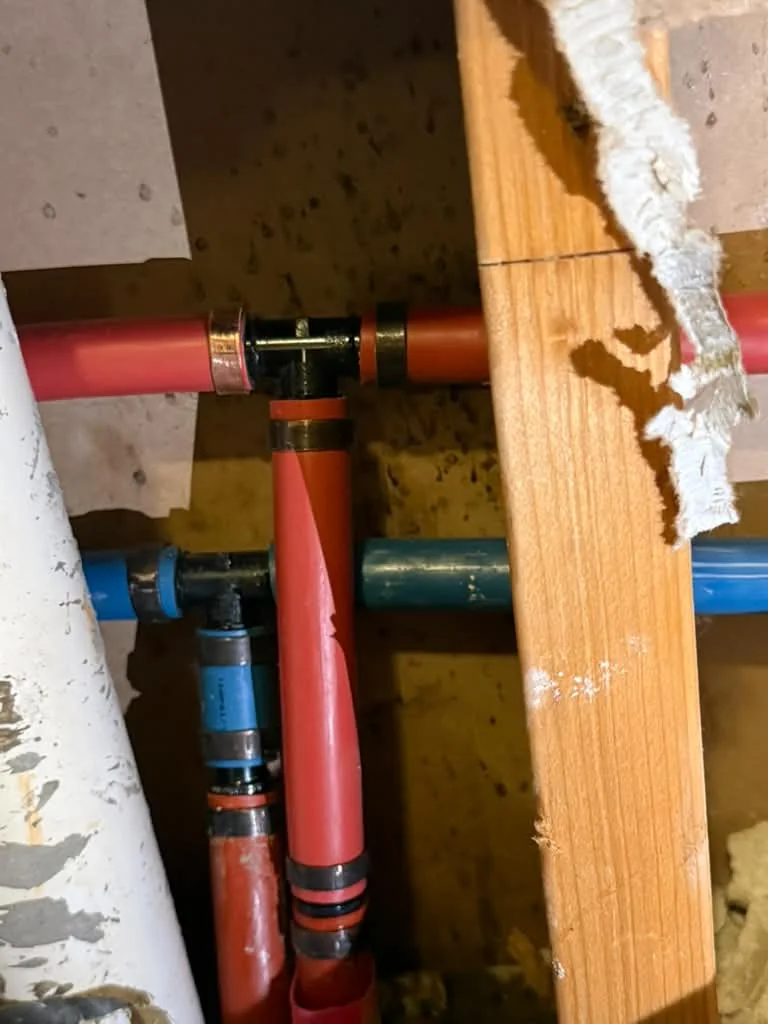
On a slab house the old supply lines often run under the floor, and nobody wants a jackhammer in the living room. So a repipe here normally runs the new lines overhead through the attic and drops them down inside the walls to each fixture. The openings are cut where a line has to come through, behind a vanity or above a tub, and kept as small as the work allows. The picture at the top of this page is that stage: red and blue PEX joined with crimp rings and tees beside a stud, the PVC drain next to it left alone. There is more of the work in the gallery.
Not every house needs the whole system replaced. If one run is bad, say the line to a back bathroom that keeps pinholing, replacing that run and tying it into sound pipe can be the right answer. When it is the whole house, you get a quote from the man doing the work before any wall is touched. James Vickers wrote in his Google review: “I was billed exactly what I was quoted from LT, not a penny over!” The full picture of repiping has its own page, and new supply lines are a sensible moment to look at the water heater they feed. (251) 421-0367 reaches Paul directly, or send him the details.
Five things that shape a repipe
A repipe is as much planning as plumbing. These are the questions that get settled before the first wall is opened.
Whole house or one run
Leaks that keep turning up in different rooms say the whole system is tired. A single bad branch, maybe the run to one bathroom, can be replaced by itself and tied back into pipe that still has years in it. Paul checks the pipe on both sides of each leak before recommending either, because that answer changes the size of the job a great deal.
A shutoff at every fixture
Older houses often have one main valve and nothing else, so a leaking toilet means the whole house goes dry while it gets fixed. On a repipe each sink, toilet and appliance gets its own quarter-turn stop, including the water heater and the washer box. The next time something drips, you close one valve and the rest of the house keeps running.
Pressure after the swap
New pipe with its full bore open can deliver more pressure than the old closed-up lines ever did, and you notice it at the faucets and at the water heater. Paul puts a gauge on the system when the work is done. If it reads high, a pressure regulator protects every new fitting and valve that just went into your walls.
What comes out of the tap
Rusty or brown water is usually galvanized pipe shedding scale, and a repipe ends that. If the color or taste hangs on after new lines are in, the cause sits upstream of the house, at the well or the supply, and filtration becomes the conversation. Either way you hear which one it is and what it would take.
Openings left clean
Every cut in the drywall is made square, kept as small as the work allows and left ready for patching. Paul tells you up front where each opening will be and why it has to be there, so nothing surprises you when you walk into a room. Plan the drywall finishing alongside the plumbing so the rooms are back to normal quickly.
Signs it is time to stop patching
One of these on its own is usually a repair. Two or three together mean the supply system is near its end.
If the water runs brown after the house sits empty for a few days
then rust is coming off the inside of the supply pipe. A filter at the sink hides it for a while. New lines take away the source, and Paul can point to the pipe that is shedding.
If you have fixed a pinhole leak and another shows up in a different room
then the pipe wall is thinning throughout the system. Chasing leaks one at a time means more opened walls and more visits than replacing the runs that are failing.
If you find gray plastic supply lines in the attic or under a sink
then the house likely has polybutylene, which tends to fail at the fittings without warning. It is worth a look even when nothing is leaking yet, because a burst line is a big water loss.
If pressure is fine at one faucet and weak everywhere else
then the trouble may be one closed-up branch rather than the whole house. That is a case for replacing a single run, and Paul will tell you so plainly before suggesting anything bigger.
How a repipe goes, in order
From the first walk-through to the final pressure test, in a house where people are still cooking, showering and doing laundry.
- Walk-through first Paul looks at the meter, the main shutoff, the water heater and each fixture, and checks the attic for a clear route. You get a quote and a plan showing where every opening will go.
- Water off in stages New lines get run and capped while the old ones are still working, then fixtures switch over in turn. The house is never left dry longer than the work actually requires.
- Lines run and crimped PEX goes in from the attic down to each fixture, joined with crimp rings and tees, with a stop valve at every connection and support wherever a line runs along framing.
- Pressure tested Before any wall is closed, the new system is put under pressure and every joint is checked for weeping. A gauge reading on the finished system shows the house sits where it should.
- Old pipe retired The old supply lines are cut free and capped so nothing is left live inside the walls, and Paul shows you every new shutoff before he packs up.
Repipe questions from Semmes owners
Still not sure? Ask Paul directly.
Will you have to tear up my slab to repipe?
Usually not. On a slab house the new supply lines are run overhead through the attic and brought down inside the walls to each fixture, which leaves the floor alone. The slab only comes into it when a line under the floor has to be reached for some other reason, and Paul will tell you before anything like that happens.
Is PEX as good as copper?
For supply lines in a house, PEX holds up well, tolerates a cold snap with less risk of splitting and needs fewer and smaller openings because it bends around framing. Copper still has its place, and if you want it, Paul can run it. He will lay out both options side by side so the choice is yours.
Can I stay in the house while you repipe?
Yes. The work is planned so the water is off as little as possible, with new lines run before the old ones are cut over. Expect some noise, a bit of dust at each opening and a stretch without water while the switch-over happens. Paul tells you ahead of time when that will be.
Do I need to repipe the whole house?
Not always. If the trouble is limited to one branch, replacing that run and tying it into sound pipe can be the right call. If the leaks are spread around the house or the pipe is polybutylene throughout, a full repipe is usually the answer that holds. Paul looks at the pipe before recommending either one.
Will my water pressure change after a repipe?
Often it improves, because the new lines are open end to end where the old ones had narrowed with rust. That can push pressure higher than you are used to, so Paul checks it with a gauge at the finish. If it reads too high, a regulator holds it in a safe range for every valve and fixture.
Who does the repipe?
Paul Evans, start to finish. He works alone on purpose, so the person who walks through your house and gives you the quote is the same person crimping fittings in your attic. He is Master Plumber MP4379 and BBB A+ accredited, and he carries his own license, bond and insurance on every job.
Tired of patching?
Tell Paul what the pipes are doing and how long it has been going on. He will come look, give you a quote and say whether a repipe is the right call or a smaller fix will hold.
Ask Paul (251) 421-0367 Send Paul a message