
Mobile, Mobile County
Sewer line repair for an old Mobile lateral that has given out
When the line from the house to the street has cracked, rusted through or let roots in at a joint, Paul Evans is the one who answers and the one who digs. He finds the break with a camera first. Then he tells you whether one section can come out or the whole run is finished.
What happens to cast iron under the yard
In the older parts of Mobile, a lot of houses went up before 1975, and the sewer lateral under those yards is often the original cast iron. Cast iron does not snap one afternoon. It rusts from the inside, scale piles up along the floor of the pipe, and in time a section wears thin enough to crack or rot out at the bottom. By then the house has usually been dropping hints for a while: a toilet slow to clear, a gurgle in the tub, a damp patch of grass that never dries. Paul works the whole city from Wilmer; his other Mobile jobs are on the Mobile page.
Nobody should start a sewer dig on a guess. Paul runs a camera down the line first, from a cleanout or the roof vent, and watches for the place where the picture changes: a crack, an offset joint, a root mat, a stretch where the bottom of the pipe is gone. The cable count says how far out the trouble is, so the dig can start there. That turns a long trench into one hole where the trouble is. If the footage shows the run failing in several places, you see that too, and the talk turns to replacing it. Photos of digs like this are in the gallery.
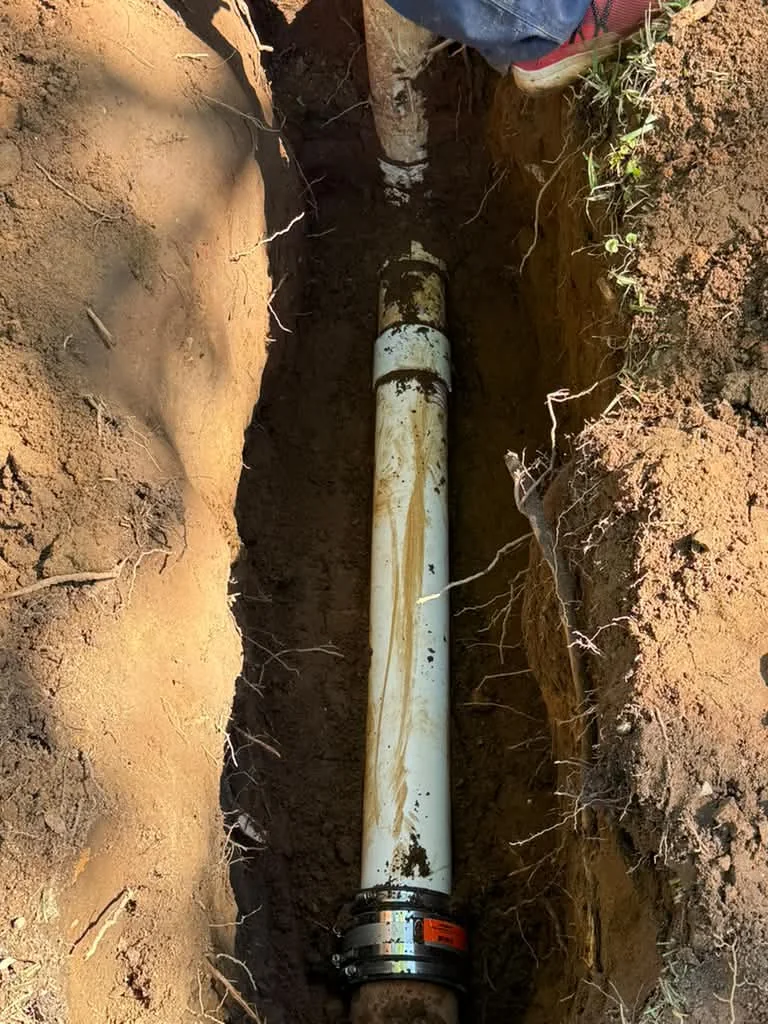
The clay under the topsoil holds a trench wall well but turns slick once it is wet, and the water table here rises fast after rain. Paul cuts the bad section out, joins new PVC to the sound pipe with banded couplings, and runs water through it before any dirt goes back. The clay goes in again in layers and gets packed, topsoil last. James Vickers put it plainly in his Google review: “I was billed exactly what I was quoted from LT, not a penny over!” Sewer line repair has its own longer page, and if a look inside comes first, see drain camera inspection in Mobile. Call (251) 421-0367 or send Paul a message.
Repair one section or replace the run
A handful of things decide whether a broken sewer gets a few feet of new pipe or a full replacement. Paul walks you through each one before the shovel comes out.
How much of the run is gone
A single crack or one joint that has shifted is a section repair. The camera shows the pipe on both sides of the break, and if that pipe still has a full wall and a clear bottom, a few feet of new PVC puts the line back in service. When the footage shows scale, cracks and thin spots every few joints, patching one just moves the failure further down.
Where the break sits
A break out in open yard is a plain dig. One under a driveway, a walk, a slab porch or a big tree is a different job, and sometimes going around the obstacle makes more sense than going through it. Paul tells you where the trouble is, how deep it sits and what is on top of it before anybody picks up a shovel.
Roots at the joints
Old cast iron joints were packed and sealed, and over decades those seals let go. Roots find the moisture, work in through the gap and grow into a mat inside the pipe. Cabling cuts them back for a while. Replacing that joint with a solid coupling is what stops them returning to the same spot, which is why Paul points it out on the footage.
Rain getting in
If a drain only backs up during heavy rain, groundwater is probably getting into the sewer through a cracked pipe, a failed joint or a loose cleanout cap. That water fills the line from outside and leaves your waste less room to move. Finding where it enters is camera work, and sealing it is often a contained repair at a single point.
What the yard looks like after
A sewer dig leaves a mound of clay beside the trench while the work is open. Paul keeps the spoil to one side, protects what he can along the way, and backfills so the ground packs down instead of slumping with the first heavy rain. Where the trench crossed lawn, expect a strip of bare soil until the grass grows back over it.
What the house is telling you about the sewer
Sewer trouble shows up in a few familiar ways. Say which one you are seeing when you call.
If every drain in the house slows at once and the lowest tub fills
then the lateral is closed somewhere past the last fixture. A cable gets it flowing, and a camera run right after shows whether it was a clog or a break that will keep catching things.
If a patch of yard stays soft or smells after a dry week
then the line may be leaking into the soil under that spot. That is often the break itself, and a camera run can confirm it before any digging starts.
If the house backs up only during a downpour
then water from the ground is likely getting in through cracked pipe or a failed joint. The fix is at the point of entry, and the camera is how that point gets found.
If roots come back on the cable after every cleaning
then a joint is open and roots are growing through it. Cutting them again buys time. Swapping that joint for a solid coupling ends the cycle at that spot.
Paul’s other jobs in Mobile
Getting ready for a sewer dig
Most of this is about keeping water out of a broken line and keeping the work area clear.
- Go easy on water Each flush and load of laundry sends more down a line that may be leaking into the yard. Use as little as you can until Paul has looked.
- Mention what is buried If you know where an irrigation line, a pet fence wire or a buried cable runs between the house and the street, tell Paul before the dig.
- Find the cleanout A capped pipe near the foundation gives the camera the cleanest way in. If there is none, say so on the phone and the roof vent gets used.
- Clear a path Move vehicles, planters and anything stored over the yard between the house and the street so the trench line is open.
- Keep pets inside An open trench in wet clay is no place for a dog. Keep animals in while the hole is open and until it is backfilled.
Asked often about broken sewers
Still not sure? Ask Paul directly.
Do you have to replace the whole sewer line if one part is broken?
No. If the camera shows sound pipe on both sides of the break, Paul cuts out the bad section and couples new PVC to the old line. Replacing the full run only makes sense when the footage shows the line failing in several places along its length, and he shows you that footage first.
Why run a camera before digging?
Because the camera tells Paul where the break is, how deep it sits and what it looks like. Digging without it means guessing, and a guess in the wrong spot is a bigger hole in your yard for nothing. With the location marked on the ground, the trench goes where the trouble actually is.
What happens to my yard?
There will be a trench and a pile of clay beside it while the work is open. Once the repair is tested, the trench is backfilled and compacted so the spot is less likely to settle later. Where the trench crossed lawn, expect a bare strip until the grass fills back in.
Can roots really break a cast iron pipe?
Roots usually get in where the pipe was already weak, at an old joint or a crack. Once inside they spread into a mat that catches everything coming down the line, and as they thicken they can pry the gap wider. Clearing them helps for a while, and fixing the joint is what keeps them out.
Why does my sewer only give trouble when it rains?
Groundwater is probably getting in. When the water table rises after heavy rain, it pushes into the sewer through cracks, failed joints or a loose cleanout cap, and the line fills from outside. A camera run shows where it enters, which is usually the spot that needs the repair.
Will I know what the job takes before the dig starts?
Yes. Paul shows you the footage, tells you where the break is and explains what the repair involves before anything is dug. The quote comes from him, the same person who will be standing in the trench. There is no salesman and no commission, so nobody gets paid more for a bigger job.
Sewer acting up?
Call and tell Paul what the drains are doing and whether rain makes it worse. You will hear his read on the problem and the soonest he can get there.
Call Paul (251) 421-0367 Send a message