
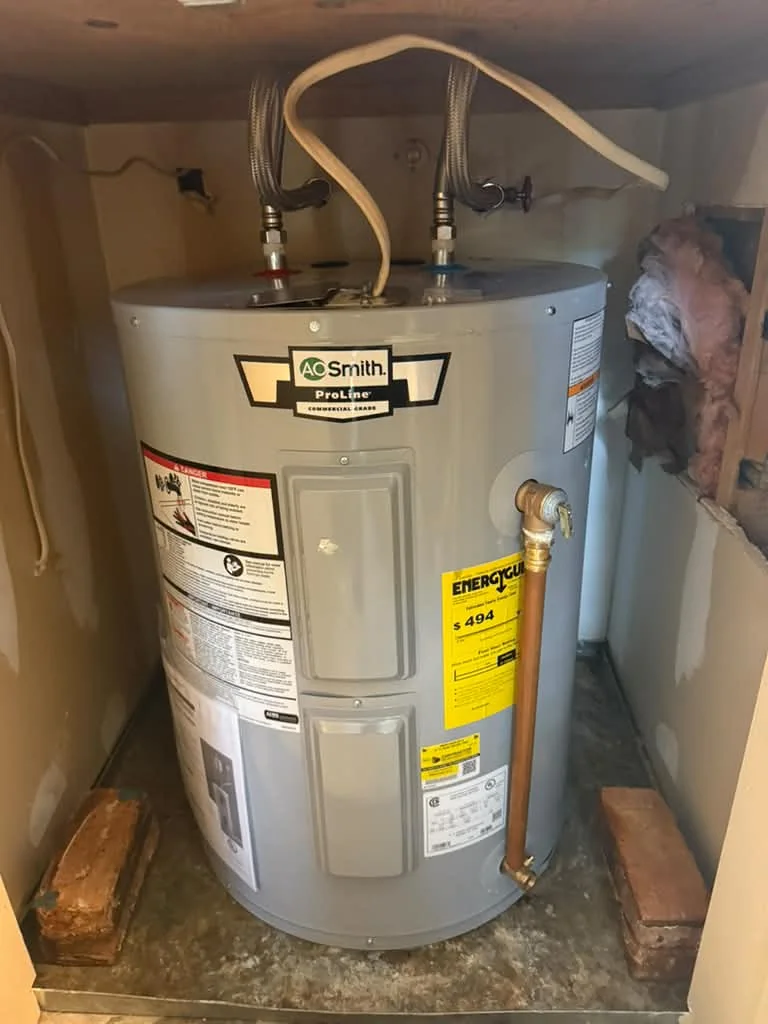
A water heater in a hall closet or a cabinet off the kitchen sits a few feet from your floors, your walls and often a bedroom. When it fails, it fails into the house. So when I replace one in a closet, the tank is only part of the job. The pieces around it are what keep the next leak from turning into a soaked subfloor, and plenty of those pieces were either never installed or have aged right alongside the old tank. Here is what I change at the same time, and the reason each one earns its spot.
Matching what the closet will hold
Closet heaters are often lowboys, short and wide, because a standard tall tank will not fit under a shelf or through the door. The replacement has to match more than the gallons printed on the label. It has to fit the width of the opening, clear the door, and leave enough room to reach the drain valve and the relief valve later on. Electric goes back in for electric unless there is a real reason to change, because switching fuel inside a closet means gas piping, venting and combustion air that the space may not be able to provide. If the old tank was crammed in with no clearance at all, I will tell you, and sometimes the new one gets set a little differently so the next person can actually service it. Knowing the dimensions ahead of time saves a second trip, which is why I ask for a photo of the label.
The pan and where it drains
The pan under the tank is your first warning. It catches a slow drip from the drain valve or a weeping fitting, so you find water in the pan instead of in the hallway carpet. Pans crack, rust through and get forgotten, and a fair number of closet heaters never had one. A new tank gets a new pan sized to fit it. A pan only does its full job when it has somewhere to send water. Where a drain line already runs from the pan to the outside or to a suitable drain, I reconnect it. Where there is none, we talk through whether one can be run. A pan with no drain buys you time and a warning. It cannot contain a tank that splits open. On uneven floors the pan sometimes sits up on bricks or blocks, and it has to stay level under the full weight of a filled tank.
New connectors and a shutoff that works
The lines tying the tank to the house are usually the first thing I replace without a second thought. Older flexible connectors, especially bare corrugated ones and the early braided kind, harden and corrode at their ends. I put on new braided stainless connectors sized to the tank, and I make sure there is a cold shutoff above the heater that actually turns. A valve that has been frozen open for twenty years is no help on the day the tank lets go. Where the copper risers are crusted green or white at the joints, I cut back to clean pipe rather than tightening onto metal that is already failing. Setting a new tank on tired connections is a common way to get a leak a couple of weeks after the job looked finished.
Why an expansion tank goes on
Water grows when it heats. In a house where the main has a check valve or a pressure regulator, that extra volume has nowhere to escape, so pressure across the whole system climbs every time the heater cycles. The relief valve may start dripping, faucets may bang, and the new tank takes strain it was never built for. An expansion tank is a small vessel with an air cushion inside that soaks up that growth. It mounts on the cold line above the heater and gets strapped to the wall so its weight never hangs on the pipe. If one is already in place, I check its air charge, because a waterlogged expansion tank does nothing at all. If the house needs one and never had it, I explain why before adding it, and you make the decision.
The relief valve and the line behind it
The temperature and pressure relief valve is the safety device on the tank. If the heater overheats or pressure spikes, it opens and dumps water rather than letting the tank rupture. A new tank arrives with a new valve, but the line running from that valve is where installs go wrong. It has to stay full size, slope downhill, end somewhere you will notice water without anyone getting scalded, and never be capped or threaded shut. In closets I regularly find old relief lines that stop a few inches above the floor behind the tank, kinked, reduced, or tied into something they never belonged in. That gets corrected during the swap. A relief line that empties hot water into a wall cavity turns a safety device into the cause of the damage.
Before anyone disconnects an electric tank, the breaker comes off and the wires get tested dead at the heater. On the new one the order reverses: fill it, bleed the air out at a hot faucet, and only then restore power. An electric element switched on in an empty tank burns out almost at once.
If your heater lives in a closet, a picture of the label and the space around it tells me most of what I need before I come. The water heater replacement in Semmes page covers the swap in more detail, and you can reach me from the contact page.
Questions people ask about this
Do I need a pan under a water heater in a closet?
In a closet, yes, I put one in. It catches drips from the drain valve and the fittings so you find water in the pan and not under the carpet. Ideally the pan drains somewhere, though that is not possible in every closet. A pan with no drain still gives you warning. It just cannot hold back a tank that ruptures.
Why did my relief valve start dripping after the new heater went in?
Often it is thermal expansion. If the house has a check valve or a pressure regulator on the main, heated water has nowhere to go and pressure rises until the relief valve opens. An expansion tank on the cold line usually stops it. High incoming pressure can cause the same drip, and a gauge threaded onto an outside spigot will show that.
Can a closet heater be switched from electric to gas?
Sometimes, but it is a bigger job than it sounds. Gas needs a supply line, a vent to the outside and enough air for combustion, and a small closet behind a solid door often cannot provide that safely. For most closet swaps, electric for electric is the clean answer. If you want to change fuel, we talk through what it would involve first.
Water heater tucked in a closet?
Send the size off the label, tell me whether it is electric or gas, and describe the closet door and the floor around it.