
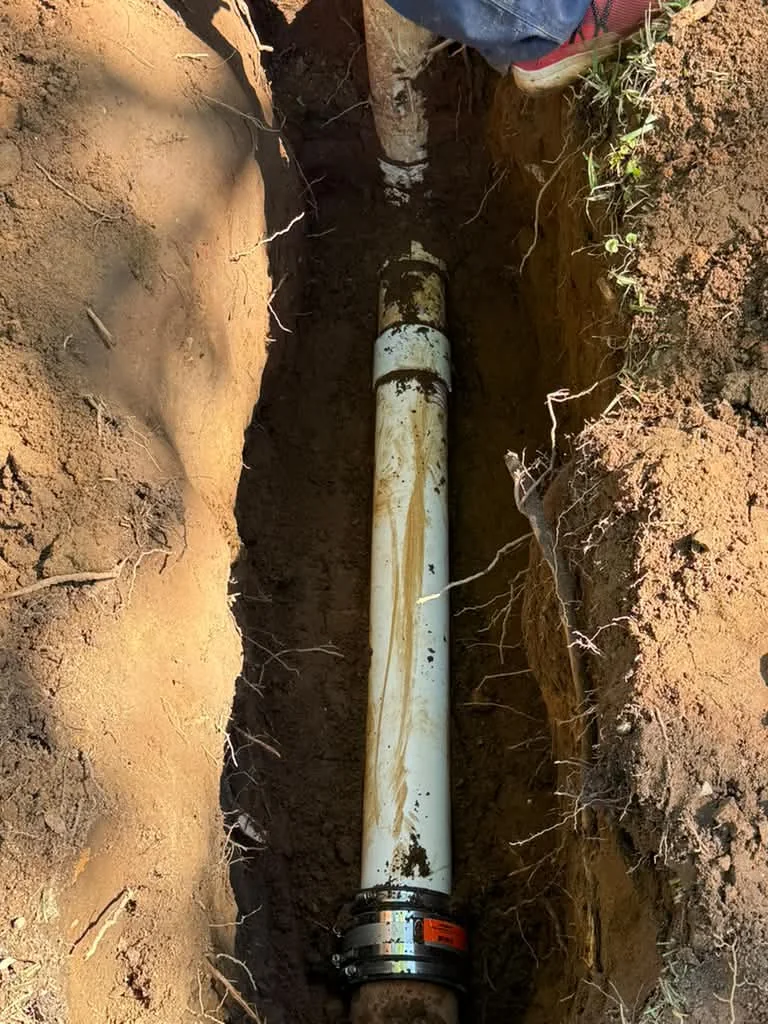
Nobody wants a trench across the front lawn to fix a pipe that turned out to be broken in one place. When a sewer or drain line fails underground, the size of the hole depends almost entirely on how well the failure was found before any digging started. A camera run does that finding. It shows what the problem is, how far out from the cleanout it sits, and which way the line travels to get there.
Why guessing at a buried pipe tears up a yard
Without a camera, the only way to find a break is to follow the line with a shovel. You start near where the pipe leaves the house and keep going until you hit the bad spot, which can mean a long trench through grass, flower beds and sometimes concrete. Even knowing roughly where the line runs does not save you much, because laterals rarely go where people expect. They bend around old trees, jog over to meet a cleanout that was added later, or take an angle toward the main that nobody ever wrote down. Digging on an assumption is how a small repair turns into a ruined lawn and a much longer job. The camera is there to stop that before the first shovel goes in.
Reading distance off the reel
I push the camera in from the cleanout and watch the screen until the head reaches the problem: the crack, the separated joint, the root mass, the place where the pipe has rusted through. Then I stop pushing and leave the head parked right there. The reel counts how much cable has gone into the line, so that number is the distance from the cleanout to the damage. The footage adds the rest of the picture. You can see on the screen where the pipe bends, where a fitting joins it and roughly which way it heads once it leaves the house. Put the two together and the break stops being somewhere in the yard and becomes a stretch of ground a few feet long.
Putting the mark on the ground
From the cleanout I measure out along the route the footage showed and put a flag or a line of paint where the count lands. I usually mark the path between the house and that point too, so you can see on the grass what is underneath before anything happens. If the line turned on its way out, the flag sits past the turn, not on a straight guess from the door. By the time digging starts, you and I are both looking at a mark on the lawn that says the pipe runs here and the trouble is about here.
Digging only what the repair needs
With the spot marked, the hole gets sized to the repair instead of to the search. That means an opening large enough to stand in, cut out the bad length and set the new piece with room to make the couplings properly, and not much more. Sod gets cut and lifted to one side so it can go back down. Dirt goes onto a tarp so it does not get ground into the rest of the lawn. Close to a foundation, the last part of the dig is done by hand so nothing gets pushed against the house. After the repair, the camera goes back through the line before anything is filled, so you see the new section on the screen while the pit is still open.
What you see before the shovel
The point of all this is that you are not taking my word for where the hole goes. While the camera sits at the break, you can look at the screen and see what stopped it: a joint that has pulled apart, a crack with dirt behind it, a root mass filling the pipe, or a stretch of cast iron with the bottom rusted out. Then we walk out to the flag together, and I show you the count on the reel and the route the footage followed to get there. If the line runs under a flower bed you care about, or past a fence post, or close to the foundation, that is the moment to say so. Sometimes the plan changes right there: a shallow line near a bed gets opened by hand, or the hole moves a foot to miss a shrub’s roots while still landing on the pipe. Nothing gets cut or dug until you have seen the problem on the screen and the spot on the ground, and you know roughly how big the opening will be.
When the count needs checking
A cable count is a good guide, and I would still rather tell you where it can mislead. A line that loops around an old tree or jogs to meet a later cleanout runs longer than the straight distance across the yard. A pipe that passes under a driveway or a slab puts the mark on concrete. Standing water after a storm can hide where the ground was disturbed before. When any of that is in play, the first opening is a small test hole to find the pipe and confirm where it runs, and the full pit only opens once the pipe is in sight. That is slower than digging on a hunch, and a lot faster than digging twice.
The camera needs a way into the line. If the cleanout cap is buried under mulch, hidden behind shrubs or covered by a deck, mention it when you call. If there is no outside cleanout at all, that changes how I get in, and it is worth knowing before I pull up.
You can read more about the camera work itself on drain camera inspection in Mobile. You can also describe your line, and anything sitting on top of it, on the contact page.
Questions people ask about this
How close does the cable count get me to the break?
Close enough to plan the dig. It measures the pipe, not the yard, so a line that bends runs a little longer than the straight distance. The footage shows those bends, and when something looks off, the first hole is a small one to find the pipe before opening the full pit.
Will I get to see the footage?
Yes. You watch the screen while the camera is in the line, and I point out the problem when the head reaches it. After a repair, the camera goes back through before the hole is filled, so you see the new section with your own eyes. If something on the screen does not make sense to you, stop me and ask. That is what the screen is for.
What if the break is under the driveway?
The camera works the same way, and the mark goes on the concrete instead of the grass. From there the choice is between cutting a small section of the driveway at that spot, or rerouting a short length of line around it if that makes more sense for your property. Either way, you see the mark and both options before anything gets cut.
Need to know where the line is broken?
Tell me where your cleanout is, what the drains have been doing, and whether a driveway or slab sits between the house and the street.