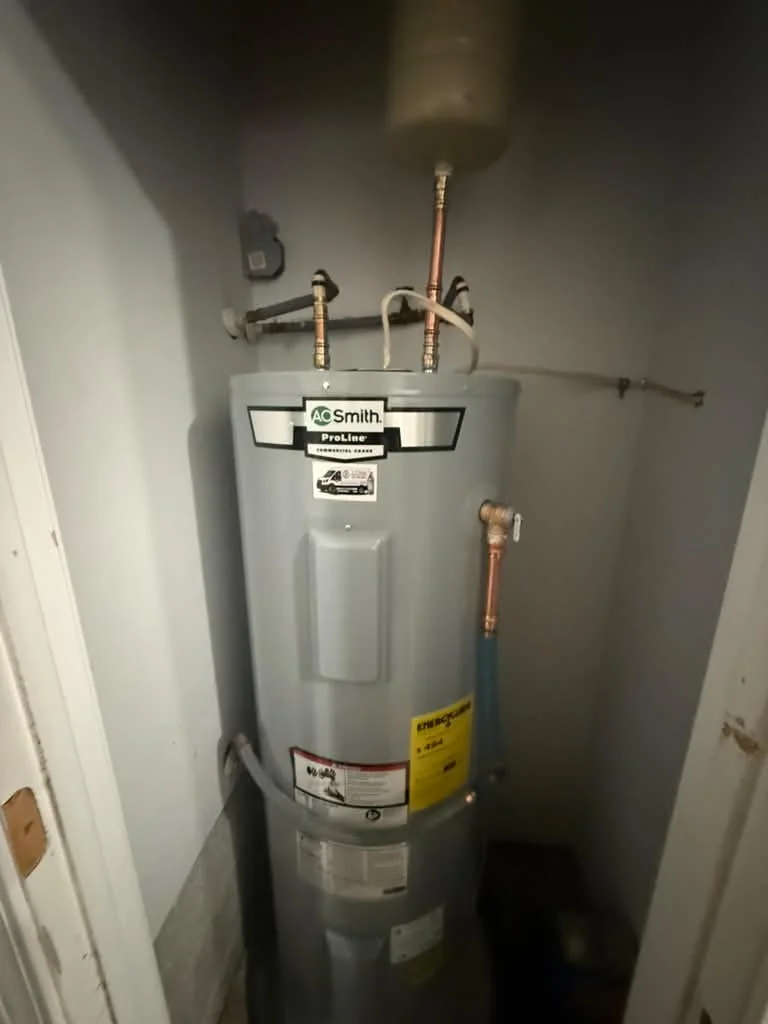
An electric water heater has fewer things to go wrong than a gas unit. There is no burner, no gas valve and no flue, just a tank, two heating elements and the controls that switch them. When one of those parts quits, you either get no hot water at all or a shower that turns lukewarm sooner than it should. Most of the time the tank itself is fine and the fix is a part.
How the two elements share the work
Most residential electric tanks have two heating elements, one near the top and one near the bottom, each with its own thermostat behind a small access panel. They take turns. When the tank is cold, the upper element heats the water at the top first, so some hot water is ready quickly. Once the top reaches temperature, its thermostat hands the power down to the lower element, which heats the rest of the tank. In most homes only one element runs at any moment. That arrangement explains the two common complaints. If the upper element or its thermostat fails, the lower one never gets its turn, and the whole tank goes cold. If the lower element fails, the top still heats, so you get a short burst of hot water and then nothing. Knowing which symptom you have narrows the search before a single panel comes off.
No hot water at all
Start at the electrical panel. A water heater runs on a two pole breaker, and if it has tripped, resetting it once is reasonable. If it trips again, leave it off, because something in the heater is drawing more than it should. If the breaker is fine, the next suspect is the high limit, a safety switch above the upper thermostat that cuts power when the water gets too hot. It has a red reset button. On many tanks you can reach it by turning off the breaker, removing the upper access panel and folding back the insulation. Pressing it once is a fair thing to try. If it clicks and the heater comes back, keep an eye on it over the next few days. A high limit that trips more than once is telling you a thermostat is stuck on or an element has shorted, and resetting it again only hides that.
Hot water that runs out fast
When the shower starts hot and goes lukewarm well before it used to, the lower element is the usual suspect. With it burned out, only the top of the tank is being heated, so you are working with a fraction of the water you are used to. A lower thermostat set too low gives the same symptom, and so does one that has drifted out of calibration. Sediment is another cause. Minerals settle at the bottom of the tank over time and build up around the lower element, where they make it work harder and shorten its life. Draining and flushing the tank helps when the buildup is caught early. Running out of hot water sooner than before is a parts problem far more often than a tank problem.
How I test the elements and thermostats
This is the part best left to someone with a meter and the habit of using it. Both thermostats sit behind panels with exposed terminals, and the heater runs on enough voltage to hurt you badly. With the breaker off, I confirm the power is actually dead at the heater before touching anything. Then each element gets checked for resistance, and for a short to the tank body, which is what trips breakers and high limits. The thermostats get checked to see whether they pass power when they should and cut it off when they should. Whatever has failed gets replaced with a matching part, and the heater is brought back on and watched while both elements take their turns. You hear what failed, why it failed, and what the rest of the heater looks like while the panels are still off and you can see it for yourself.
When it is a repair and when it is not
Elements and thermostats are replaceable parts, and on a tank that is not leaking, replacing them is the sensible fix. I will tell you that even when the heater has some age on it. What changes the answer is the tank itself. Water seeping from the bottom, rust coming through the jacket, or a pan underneath that keeps collecting water all point to a tank failing from the inside, and no part will fix that. Close to the bay and the Gulf, the fittings on top of a water heater corrode faster than they do inland, so I always look at them. Green or white crust on those connections is a slow weep worth catching before it turns into a puddle in the closet. If the tank is sound, you get a repair. If it is not, you hear why, and the decision stays yours to make.
Brynn Burkmier wrote: “Our water heater went out on a Friday and I was so worried we wouldn’t have hot water for the weekend. Called and they showed up in less than 30 mins!!” Call when it happens. The person who answers is the one who shows up.
I keep a fuller write-up of tank repairs, gas and electric, on water heater repair in Mobile. If your heater is doing something not described here, tell me about it on the contact page.
Questions people ask about this
Is it safe to press the red reset button myself?
Once, with the breaker turned off before the panel comes off, yes. The button sits behind the upper access panel, under the insulation, and you should never touch the wiring terminals around it. If the heater works again afterward and keeps working, it may have been a one time trip. If it trips a second time, stop resetting it and call, because something is causing it.
Why does my electric heater crackle or hiss?
Usually that is scale on the lower element. Minerals coat the element and water boils against it in small pockets, which makes the sound. It is a sign the tank needs flushing and that the element is working harder than it should. It is not an emergency, but it is worth dealing with before the element burns out and you lose most of your hot water.
Can a bad thermostat make the water too hot?
Yes. A thermostat that sticks closed keeps the element on past the set temperature, and the high limit is what finally shuts it off. Water that comes out scalding, or a high limit that keeps tripping, both point that way. Either one deserves a call rather than another reset, because the safety switch was never meant to be what controls your water every day.
Electric heater gone cold?
Tell me whether there is no hot water at all or it just runs out fast, and whether the breaker or the red reset button has tripped.