
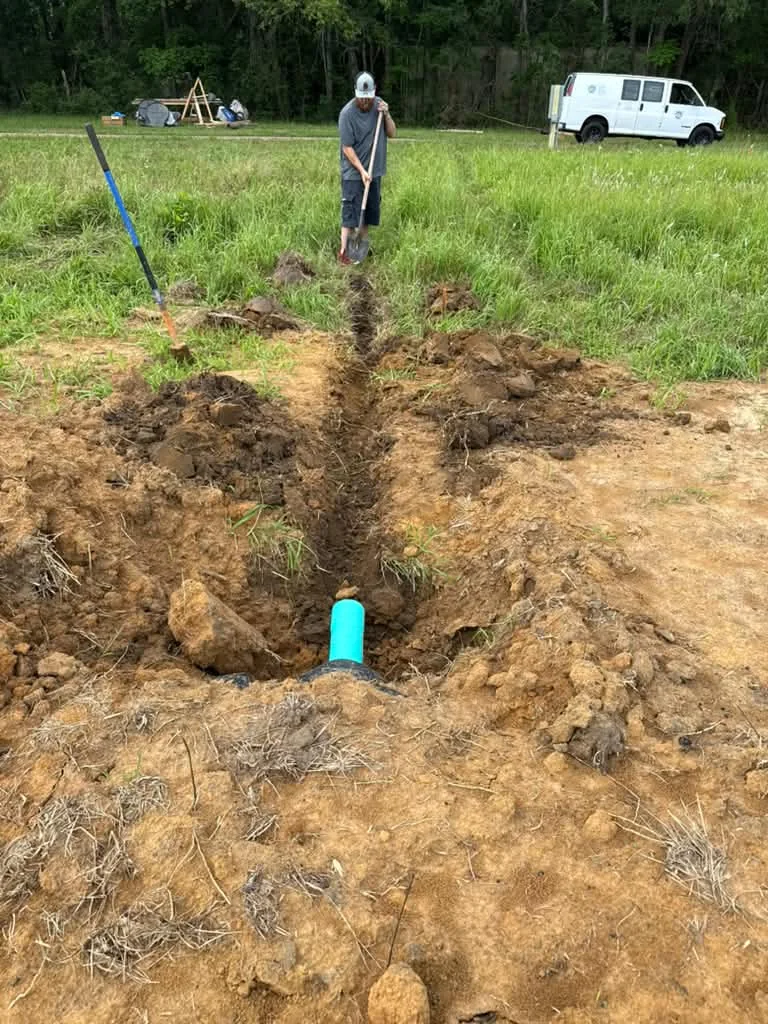
Sewer trouble in an older house usually starts one of two ways: a tub that drains slow and then backs up when the washer empties, or a patch of yard that stays wet after everything else has dried. A lot of the county was built before 1975, and plenty of those houses still send their waste out through the cast iron they started with. Once I find the break, the decision becomes whether to fix that one spot or replace the whole run out to the main.
What the camera has to show me first
I do not decide anything from the doorway. The camera goes in at the cleanout and travels the whole lateral, out to where it ties into the main, and I record it. The break is usually obvious when the head reaches it: a crack, a hole in the bottom of the pipe, a joint pulled apart, or roots packed into a seam. What matters just as much is everything else on that footage. Is the pipe on either side still round, with walls that look like metal? Or is the bottom rusted thin and the water channel running through scale? Are there roots at three joints or only one? Is there a belly where water sits instead of moving along? One broken spot inside a line that otherwise looks sound is a very different job from a break that is simply the worst place in a pipe failing everywhere. You watch the same footage I do, and I point out what I am looking at as it goes by.
When cutting out one section is enough
If the damage sits in one place and the pipe on both sides still has good walls, I fix the one section. That means digging down to the break, cutting out the bad length, and setting a new piece of PVC in its place with shielded couplings at each end where it meets the old cast iron. The new section gets proper bedding under it so it does not settle and start a new low spot of its own. A single root intrusion at one joint, one crack, or one place where the pipe was crushed are all good candidates. It is a smaller dig, the yard closes back up sooner, and the rest of the line keeps doing its job. There is no reason to sell somebody a full replacement when the camera shows a pipe with plenty of life left in it apart from a foot or two of bad pipe. A small repair should stay a small repair, and if that is what your line needs, that is what you hear from me.
When patching starts to cost you twice
Some lines are past that point. When the camera shows rust through the bottom of the pipe in several places, scale closing the channel along most of the run, or roots coming in at joint after joint, a repair at the worst spot only moves the problem down the line. The coupling on the end of the new section is clamped onto old pipe that is just as weak as the piece I cut out, and the next break shows up a few feet away. That is when I tell you the whole lateral is the better use of your money, even though it is the bigger job. Replacing the run from the house to the main means one excavation plan, new pipe the whole way, and no second dig waiting for you down the road. I would rather say that plainly on the first visit than come back to the same yard twice and have you wonder why I never mentioned it.
What wet ground does to a buried line
The soil around here plays a part in all of this. A lot of Mobile County is sandy loam over clay, and the water table comes up fast after a heavy rain. Ground that swells and settles keeps working on buried pipe, and the weak point is almost always a joint or a transition between two materials, where the line starts weeping instead of breaking clean in the middle. That same rain finds its way into a cracked sewer, so a line with a few bad joints can run fine through a dry week and back up during a downpour. If your drains only misbehave when it rains, that is useful information, and I want to hear it. It also shapes the repair itself. New pipe needs firm, even bedding and careful backfill, because a section dropped into soft ground and covered without care will sink and start holding water again.
How the decision gets made
Once the footage is done, you get both options laid out side by side: what a section repair involves, what full replacement involves, where each dig would go, and what happens if you wait. I do not have a quota to hit and nobody pays me more for selling the bigger job, so the recommendation comes from the camera. Sometimes the honest answer is a section now and a plan for the rest later, because the line still has some service in it and you would rather budget for the full run. That is a reasonable choice, and I will tell you what to watch for in the meantime. Whichever way you go, the quote you agree to is what you pay. James Vickers put it this way after his job: “I was billed exactly what I was quoted from LT, not a penny over!” That holds on every sewer job, large or small.
Stop running water anywhere in the house, including the washer and the dishwasher, and keep people off the lowest drain. Skip the chemical openers. They will not clear a broken pipe, and they sit in the line waiting for whoever opens it next.
For the dig itself, from the camera run through the backfill, see sewer line repair in Mobile. If you would rather describe what your drains are doing first, the contact page reaches me directly.
Questions people ask about this
Can one bad section be fixed without digging up the whole yard?
Yes, when the rest of the line is sound. The camera locates the break and how deep it sits, and the dig happens right there. The opening only needs to be large enough to cut out the damaged length and set the new piece. Most of the yard never gets touched, and the sod that comes up goes back down once the hole is filled.
Will new PVC connect to my old cast iron?
It does, with shielded couplings made for joining the two materials. Each coupling has a rubber sleeve that seals around both pipes and a steel band that keeps them lined up. What matters is the condition of the cast iron the coupling clamps onto. If that pipe is rusted thin, the connection is only as good as the old metal, which is part of the decision.
Does a whole new lateral mean my yard gets torn up?
It means a bigger dig than a section repair, but it is planned ahead. The route follows the existing line from the house to the main, and we talk beforehand about what is in the way, such as a driveway, a fence or a bed you care about. Sod gets cut and set aside where it can be, and the trench is filled and compacted after the new pipe passes a test.
Sewer acting up in an older house?
Tell me what is backing up, where the cleanout is if you know, and whether it gets worse when it rains.